

Battery quotes love one word: arbitrage. Charge when power is cheap, discharge when it's dear, pocket the gap. What the quote never prints is a ceiling, the most you could pay before the gap stops covering the hardware. This post computes that ceiling.
I haven't installed or tested a battery for this. What I did run is a model. I pulled 35,040 quarter-hour German day-ahead prices and 17,520 half-hour UK Agile prices for each direction, covering 23 October 2025 to 22 October 2026. Then I set a battery against the warranty terms in Tesla's and Enphase's own documents. The script is about 300 lines of plain Node, and the two ideas inside it fit in a paragraph each.
What Does a Battery Have to Earn Per kWh?
Every kWh a battery delivers pays out a sell price and costs a buy price, plus the energy lost on the way. Enphase's IQ Battery 5P datasheet (DSH-00010-11.0) lists 90 percent AC round-trip efficiency. So one kWh out needs 1.11 kWh in, and the buy price counts 11 percent extra.
value per kWh delivered = sell price - (buy price / 0.90)That's the revenue side. The cost side is the warranty, because the warranty is the only lifetime a manufacturer will put in writing. Here are the two terms I used:
| Tesla Powerwall 3 | Enphase IQ Battery 5P | |
|---|---|---|
| Term | 10 years | 15 years or 6,000 cycles, whichever comes first |
| Capacity kept | 70% of 13.5 kWh at year 10 | more than 60% |
| Cycle limit | unlimited for solar self-consumption, time-of-use shifting and backup; 37.8 MWh of throughput for anything else | 6,000 |
| Document | Powerwall Limited Warranty (USA), Rev. 2.6, effective May 6, 2026 | Data sheet DSH-00010-11.0, May 2025 |
I assumed capacity fades in a straight line from 100 percent to the warranty floor. That's my assumption, not a forecast, since a warranty is a floor. Under it, a Powerwall 3 cycled daily for ten years delivers 3,103 kWh per kWh of usable capacity (365 x 10 x 85 percent average). The 5P delivers 4,380 over fifteen years (365 x 15 x 80 percent).
Divide an installed price by those numbers and you get the wear cost of every kWh you move. At 800 per usable kWh that's 25.8 per kWh for the Powerwall 3 and 18.3 for the 5P. Same currency, so 25.8 cents or pence.
Divide the installed price per usable kWh by about 3,100 and that's what every kWh a Powerwall 3 cycles costs in wear before it earns a cent.
What Did a Year of Real Prices Say?
Per kWh of usable capacity, the model plans each local day with full knowledge of that day's prices, one cycle at most, battery empty at midnight, a two-hour battery. Is perfect foresight cheating? Partly. It's generous, but day-ahead prices really are published the day before. Octopus says Agile rates land between 4pm and 8pm, usually near 4pm.
| Scenario (12 months unless noted) | Value per usable kWh per year | Per kWh delivered | Break-even price, Powerwall 3 / Enphase 5P |
|---|---|---|---|
| Germany, day-ahead wholesale, EUR | 49.45 | 13.5 c | 420 / 593 |
| Germany, with a flat EUR 0.20 retail adder | 41.36 | 11.5 c | 352 / 496 |
| UK Agile import, offsets own use, GBP | 85.45 | 23.4 p | 726 / 1,025 |
| UK Agile import, export on Agile Outgoing | 21.09 | 7.4 p | 179 / 253 |
| UK Flux, offsets own peak use (snapshot, 365 cycles) | 70.89 | 19.4 p | 603 / 851 |
| UK Flux, exported at peak (snapshot, 365 cycles) | 45.07 | 12.3 p | 383 / 541 |
The break-even price is the most you could pay per usable kWh and still recoup it inside the warranty, undiscounted. At a 5 percent discount rate, which is my assumption, the German wholesale figure drops from 420 to 337 and UK Agile from 726 to 583.
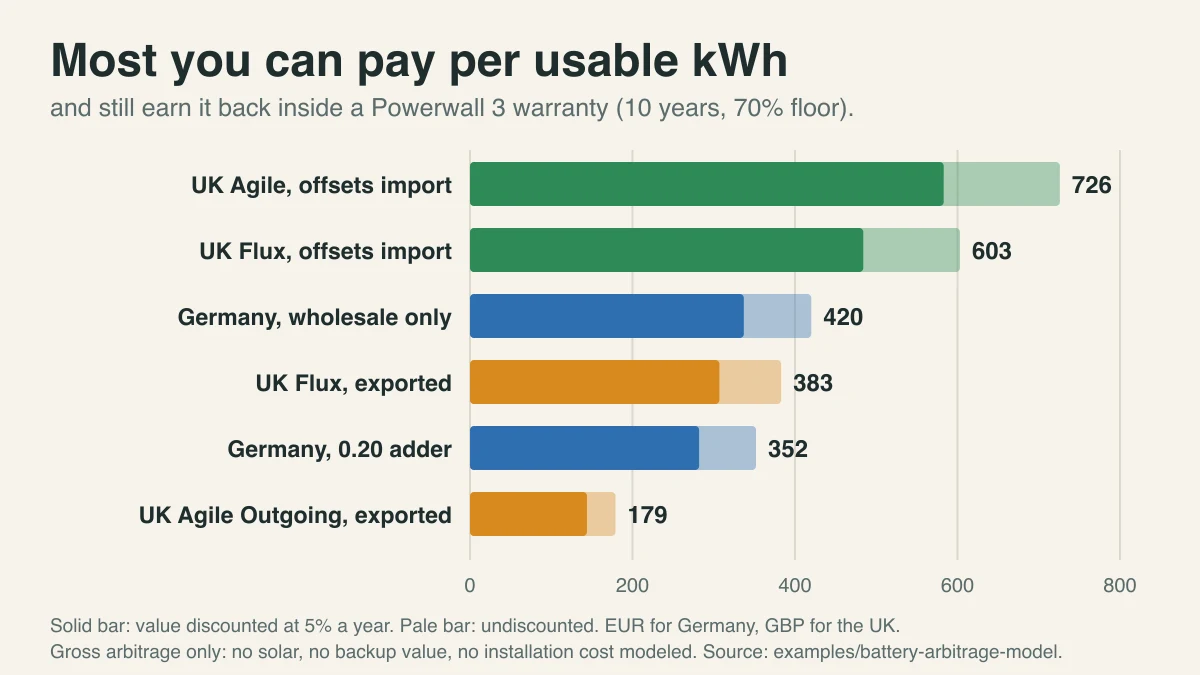
Two rows deserve a second look. Why does the German adder row lose money? Because the adder applies to the losses too. You buy 1.11 kWh at retail to deliver 1, so a flat 0.20 adder costs about 2 cents per kWh cycled. That's 8 euros a year per usable kWh, which matches the table.
And why is exporting so poor? Over the year Agile import averaged 20.58p and Agile Outgoing, which Octopus bases on the day-ahead wholesale rate, averaged 11.57p. Selling gives up about 9p per kWh before a single loss. Offsetting your own import keeps it. In the export case the battery moved money on only 317 days and ran 284 cycles.
Flux, for the record, is a fixed three-band tariff for solar and battery owners. I read its rates from Octopus's public API for region C on 23 October 2026: 16.17p off-peak (02:00 to 05:00), 37.38p at peak (16:00 to 19:00), and an export rate of 30.31p at peak. That's one day's rates, not a year, so I assumed a full cycle every day and the table says so.
Why Does a Fixed Schedule Lose So Much in Germany?
I ran a naive plan too: charge 02:00 to 04:00, discharge 17:00 to 19:00, every day. In the UK Agile data it kept 80 percent of the best plan's value and never lost money. In Germany it kept 12 percent, 5.85 euros against 49.45, and lost money on 129 days.
Twelve percent looked like a bug, so I double-checked by averaging the prices by local hour. It isn't one. German day-ahead is cheapest at 13:00, around 5.1 cents per kWh, thanks to midday solar, and it sits near 10.4 cents at 03:00. The evening peak at 19:00 averages 16.1 cents. A battery charging overnight buys at the wrong time. The year also held 1,904 negative quarter-hours (about 476 hours) that a midday plan can chase and a night plan can't.
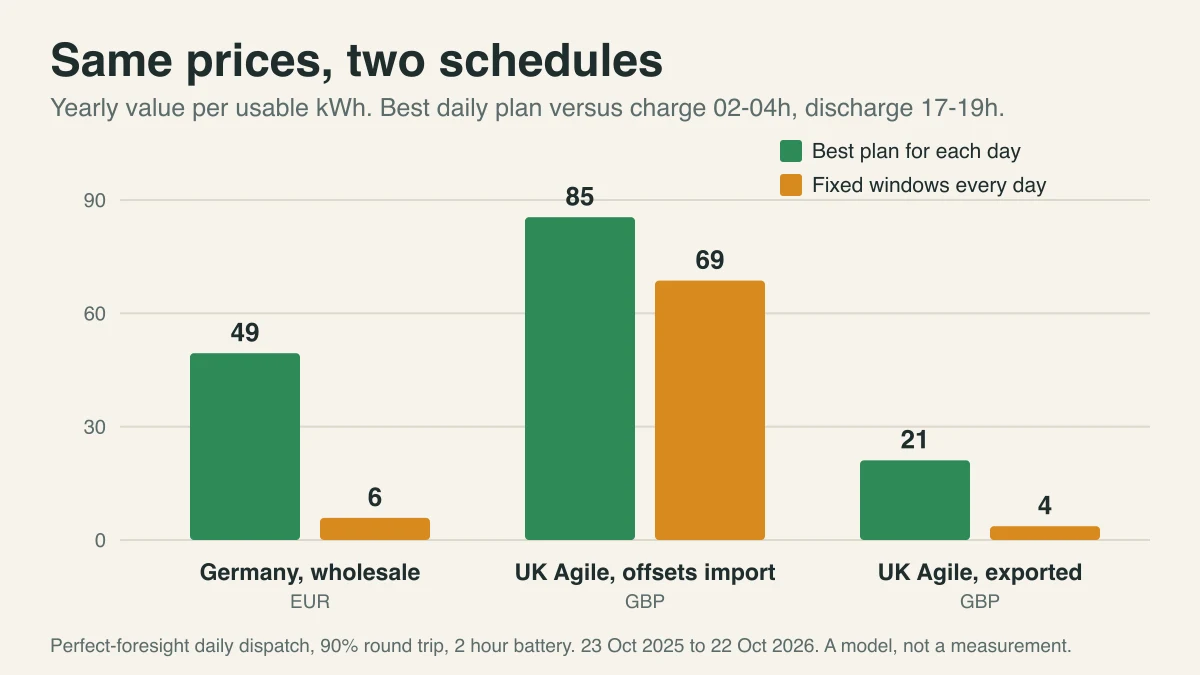
The UK looks friendlier because Agile's dip near 15.0p at 13:00 and 16.2p at 03:00 are both cheap, and the 16:00 to 19:00 band runs 32 to 38p. Overnight charging works there. It doesn't work everywhere. A dynamic-tariff battery has to follow prices, so before you buy, ask the installer whether the controller really does that or just runs a clock.
What Does the Powerwall 3 Throughput Cap Change?
Tesla's footnotes exempt three uses from the cycle limit: solar self-consumption, time-of-use load shifting, and backup. The footnote defines load shifting as storing grid or solar energy and using it for time-of-use load shifting, which reads to me as covering your own consumption. Everything else gets 37.8 MWh of throughput, measured at the AC output.
That's 2,800 full cycles of 13.5 kWh, or 7.7 years of daily cycling. If grid export for market arbitrage counts as "anything else", and my reading is that it does, though I can't confirm Tesla's view, the break-even price falls by about a fifth: 420 to 336 in Germany and 726 to 580 on Agile. Enphase's 6,000-cycle cap is slacker. At one cycle a day it ends after 16.4 years, past the 15-year term.
Here's the part I'd argue about. A battery you buy for backup or solar self-consumption can treat arbitrage as a bonus. A battery you buy for arbitrage alone is a bet on a tariff, and in Germany the numbers say you'd lose it. Look at 420 euros next to the 550 to 1,200 euros per usable kWh that our EU battery guide quotes from Lumenhaus. It sits below even the low end. It's also well under the roughly $998 per kWh that our Powerwall 3 and IQ 5P comparison cites from EnergySage, currencies aside. I haven't re-checked either quote.
Where Is the Model Too Kind, and Where Too Harsh?
Too kind first. It assumes the house absorbs every discharge. Emptying 13.5 kWh in two hours needs a 6.75 kW load, and plenty of homes don't pull that in the evening. A smaller battery that fits your peak-window demand beats a bigger one that spills into the grid at export rates. The model also ignores standby losses, inverter replacement and financing. The 90 percent efficiency was measured at half power.
Too harsh, too. It stops at the end of the warranty, and cells can outlast that. The cycling study by Preger and colleagues found LFP cells reaching about 2,500 to 9,000 equivalent full cycles before 80 percent capacity across their test matrix, against 200 to 2,500 for NMC and 250 to 1,500 for NCA. Most LFP cells hadn't hit 80 percent when it ended, so those figures are extrapolations. It adds no backup value and no solar. And the German figures are wholesale, before VAT.
Solar changes the buy price. A kWh charged from your roof costs you its export credit, not the grid price, so plug your export rate into the same formula. Our battery sizing guide works a US-style tariff example through it, and the hidden-cost guide covers lines no calculator asks about.
How Do You Run It on Your Own Tariff?
Two numbers and a division. Take your sell price minus your buy price over 0.90, then the installed price per usable kWh over about 3,100. If the first beats the second after the discount rate you trust, arbitrage covers the hardware on its own. If not, it's a bonus.
// price: installed cost per usable kWh. fade: average capacity kept over the warranty.
function wearPerKwh(price, years, fade, cyclesPerYear) {
  const delivered = years * cyclesPerYear * fade;
  return price / delivered;
}
// Powerwall 3, daily cycling: wearPerKwh(800, 10, 0.85, 365) = 0.258
To see the daily price shape for ten markets before you commit, try the battery sell hours calculator. It shows the spread this model needs. The two units discussed here have pages too: the Tesla Powerwall 3 and the Enphase IQ Battery 5P. For how the 5P pairs with inverters, see battery inverters compared.
Summary
On 12 months of real prices, home battery arbitrage covers the hardware inside a warranty only when the installed price is low and the tariff is built for it. German wholesale supports about 420 euros per usable kWh on a Powerwall 3 warranty, UK Agile about 726 pounds when the battery offsets your own import, and exporting supports far less. A fixed overnight schedule works on Agile and fails in Germany. Treat arbitrage as the bonus, and buy for backup and solar self-consumption.