

Every MPPT box on the market quotes the same number. Victron's SmartSolar data sheet says an ultra-fast MPPT controller improves harvest "by up to 30%" against PWM. EPEVER's Tracer AN G3 manual says 20% to 30%. So is it 30%?
No. It's whatever the gap between your panel voltage and your battery voltage lets it be, and that gap swings from almost nothing to roughly double.
I didn't bench-test a controller for this piece. I read the data sheets of four 20 A units, two PWM and two MPPT, plus the panel sheet from one maker, and wrote about 170 lines of Node that turn those printed numbers into watts. Every figure below is either copied from a manufacturer document or comes out of that script, and I'll say which.
Why Does PWM Lose Power in the First Place?
A PWM controller is a fast switch between the panel and the battery. When it's closed, the two are wired together, so the panel runs at battery voltage. That's the whole story.
Below its maximum power point, a panel's current barely moves as voltage drops. Power is volts times amps. So if a panel wants to run at 18.2 V and the battery holds it at 13.0 V, about 29% of its voltage goes unused, and most of that share of its power goes with it (25% in my model, because the current at 13 V is slightly higher than at Vmp).
An MPPT controller is a DC-DC converter instead. It lets the panel sit at its maximum power voltage (Vmp), then steps that down to battery voltage and turns the surplus volts into extra amps. EPEVER's manual puts it plainly: because Vmp is higher than battery voltage, battery current ends up higher than panel current. The cost is conversion loss, which both MPPT makers here print as 98% at best.
Which raises the only question that matters: how far above the battery does your panel's Vmp sit? If you need a refresher on Voc versus Vmp, the solar panel voltage guide walks through both.
What Do the Four Datasheets Actually Say?
I picked units that share a rated charge current, 20 A, so the comparison isn't stacked. Victron and EPEVER both sell a PWM and an MPPT model at that size.
| Spec (maker's sheet) | Victron BlueSolar PWM-Pro 12/24-20 | EPEVER LandStar LS2024B | Victron SmartSolar MPPT 100/20 | EPEVER Tracer2210AN G3 |
|---|---|---|---|---|
| Type | PWM | PWM | MPPT | MPPT |
| Rated charge current | 20 A | 20 A | 20 A | 20 A |
| Max PV voltage | 28 V (12 V system), 55 V (24 V) | 50 V open-circuit | 100 V open-circuit | 100 V at min. operating temp, 92 V at 25 C |
| PV power rating | none printed | "no fixed max. PV power limit" | 290 W at 12 V, 580 W at 24 V | 260 W at 12 V, 520 W at 24 V |
| Peak efficiency | not printed | not printed | 98% | 98% DC/DC, tracking above 99.5% |
| Tracking window | n/a | n/a | starts above battery + 5 V, runs down to battery + 1 V | battery + 2 V to 72 V |
| Self-consumption (12 V) | under 10 mA | 8.4 mA or less | 10 mA, load off | 8 mA or less |
| Operating temperature | -20 to +50 C | -35 to +50 C | -30 to +60 C, full output to 40 C | -25 to +45 C at full load |
| Price, 2026-10-30 | $56.70, Island Water World | not pinned | $97.79, Lotz Outdoors | not pinned |
Three things jump out. Neither PWM sheet prints an efficiency, which is honest, because the switch isn't where the loss is. The voltage ceilings differ wildly: 28 V on the Victron PWM at 12 V, 50 V on the EPEVER PWM, 100 V on both MPPT units. And Victron's PWM sheet carries a footnote I wish more buyers read: for 12 V use 36-cell panels, for 24 V use 72-cell panels.
I couldn't pin a current, single-retailer price for either EPEVER unit. Marketplace listings swing between wholesale lots and regional stores, so I left those cells empty rather than guess.
Which Panels Did I Run Through the Model?
Two modules from Victron's BlueSolar Monocrystalline data sheet, both at standard test conditions (1000 W/m2, 25 C):
| Panel | Cells | Pmax | Vmp | Imp | Voc | Isc |
|---|---|---|---|---|---|---|
| BlueSolar 150W-12V | 36 | 150 W | 18.2 V | 8.25 A | 22.3 V | 8.69 A |
| BlueSolar 305W-20V | 60 | 305 W | 32.5 V | 9.38 A | 39.7 V | 10.27 A |
The sheet gives the temperature behavior too: power -0.45% per degree C, Voc -0.35% per degree C, Isc +0.04% per degree C. Victron marks the 305 W module as discontinued. I kept it anyway, because a 60-cell panel at about 32 V Vmp is exactly what people pull off a house roof and try to reuse on a van or a cabin.
The assumptions are mine, and you should know them. The battery sits at 13.0 V (or 26.0 V) in bulk charge. I scaled Vmp with the Voc coefficient, since the sheet gives none for Vmp. For PWM, the current at battery voltage comes off an I-V curve drawn through the three points the sheet does give: Isc at 0 V, Imp at Vmp, zero at Voc. Wire and switch losses are ignored, which flatters PWM a little. Cell temperatures of 10, 25 and 55 C stand in for a cold clear day, the lab, and a hot roof.
How Much Does MPPT Gain, Panel by Panel?
Here's the core result, MPPT watts against PWM watts at full sun:
| Pairing | Cell temp | Available | PWM | MPPT 100/20 | MPPT gain |
|---|---|---|---|---|---|
| 150 W, 36-cell, 12 V battery | 10 C | 160 W | 112 W | 157 W | +40% |
| 25 C | 150 W | 113 W | 147 W | +30% | |
| 55 C | 130 W | 113 W | 127 W | +12% | |
| 305 W, 60-cell, 12 V battery | 10 C | 326 W | 133 W | 260 W | +96% |
| 25 C | 305 W | 133 W | 260 W | +95% | |
| 55 C | 264 W | 135 W | 259 W | +91% | |
| 305 W, 60-cell, 24 V battery | 10 C | 326 W | 264 W | 319 W | +21% |
| 25 C | 305 W | 265 W | 299 W | +13% | |
| 55 C | 264 W | 257 W | 259 W | under 1% |
The two PWM units come out identical, and so do the two MPPT units, because the model only knows what the sheets print: 20 A and 98% on both trackers. The 30% claim lands once, on a 36-cell panel at 25 C. That's the lab case. Every other row is either well below or far above it.
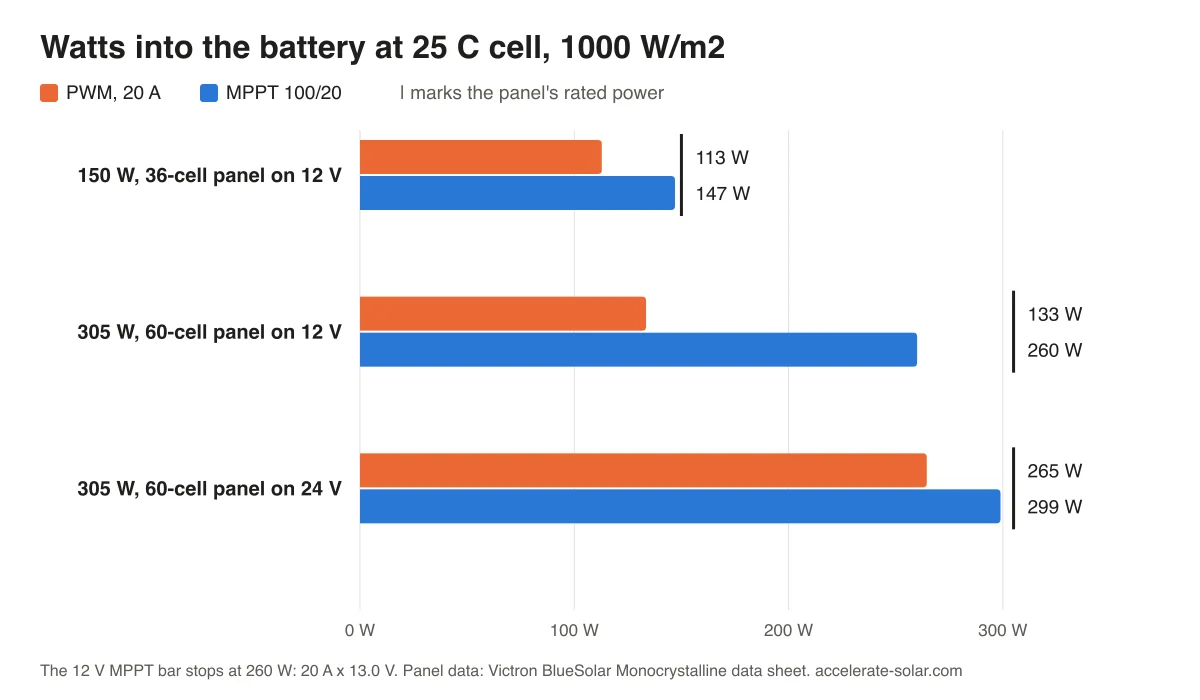
Notice what the PWM column does. It barely moves with temperature. Why? PWM output is tied to battery voltage times panel current, and current hardly changes with heat (+0.04% per degree on this sheet). MPPT output tracks the panel's real power, which climbs in the cold. So the colder and brighter the day, the more PWM leaves behind. That's the same physics behind panels producing more in cold weather, and PWM simply can't collect the bonus.
An MPPT controller isn't 30% better than PWM. It's as much better as your panel's voltage is higher than your battery's, which my datasheet model put anywhere from under 1% to 96%.
Can a PWM Controller Even Take That Panel?
This is where the datasheet limits matter more than the harvest numbers. Open-circuit voltage rises in the cold, and a controller's maximum PV voltage is a hard line.
At -20 C cell temperature (a clear winter dawn, before load pulls the voltage down), the model gives:
- 150 W, 36-cell panel: 25.8 V. Fine on the Victron PWM-Pro's 28 V limit, with about 2 V to spare.
- 305 W, 60-cell panel: 46.0 V. That's over the PWM-Pro's 28 V at 12 V, so Victron's own PWM is out. EPEVER's LS2024B, at 50 V, will accept it, and then hand you 133 W of a 305 W panel.
- Two 305 W panels in series: 91.9 V. Under the 100 V ceiling on both MPPT units, but close enough that I wouldn't add a third. EPEVER also says 92 V at 25 C, and this string reads 79.4 V there.
There's a current rule too. EPEVER's LS-B product page says the array's short-circuit current needs to be lower than the controller's rated charge current. Two 305 W panels in parallel on that 20 A PWM give 20.54 A of Isc, which breaks it. In series on an MPPT unit, the same pair is 10.27 A against Victron's 20 A short-circuit limit.
Then the edge case nobody warns you about. On a 24 V battery in summer, the 60-cell panel's Vmp drops to 29.1 V in my model. Victron's PWM-Pro absorbs at 28.8 V by default. With 0.3 V of headroom, any low-light hour or long cable pushes the panel below the battery, which is why Victron's footnote asks for 72 cells at 24 V and not 60.
Is the MPPT Upgrade Worth $41?
At the two prices I could confirm on 2026-10-30, Victron's SmartSolar MPPT 100/20 cost $97.79 and its BlueSolar PWM-Pro 20 A cost $56.70. That's a $41.09 gap for the same rated current.
On the friendliest PWM case, one 150 W 36-cell panel at 25 C, MPPT adds 34 W. Is that worth $41? Assume four hours a day of full-sun-equivalent charging while the battery still wants it (my assumption, not a measured figure) and that's about 136 Wh a day. In winter, at the 10 C row, it's 45 W.
But there's a catch the harvest table hides. Extra watts only count while the battery accepts them. Once it hits absorption and float, both controllers throttle back, and what happens to the surplus is its own topic: where surplus solar goes. A cabin battery that's full by 11 a.m. most days won't see half of that 136 Wh.
My take, and you can disagree: for a single 36-cell panel keeping a 12 V battery topped up, PWM is a reasonable buy. For anything else, a 60-cell panel, a series string, a 24 V bank on a hot roof, a winter-heavy site, the MPPT unit pays for itself in the wiring options alone.
What If the MPPT Controller Is Too Small?
Look at the 12 V, 60-cell row again. The MPPT 100/20 delivers 260 W while the panel offers 305 W. That's not a tracking problem, it's arithmetic: 20 A times 13.0 V is 260 W. EPEVER prints the same ceiling, 260 W at 12 V. Victron's 290 W works out to 14.5 V at 20 A, which is a battery near its absorption voltage, not one in bulk.
So a 20 A MPPT controller is undersized for a 305 W panel on 12 V. Doubling battery voltage fixes it on paper (the 24 V rows never clip), which is the same reason the off-grid package guide leans toward 48 V banks for anything house-sized. Grid-tie string inverters such as the Growatt MIN 6000TL-XH take this further, tracking strings of hundreds of volts, which is why nobody puts PWM on a roof array.
What Can't This Comparison Tell You?
Quite a bit, and it's worth listing.
- No unit was tested. Every limit is a printed one. I haven't confirmed that any controller meets its sheet.
- Peak efficiency isn't typical efficiency. Both MPPT makers print 98% as a maximum; real conversion at part load is lower. EPEVER's manual includes efficiency curves, but as images I couldn't read numbers from, so the model uses the peak.
- Full sun only. At low irradiance, panel voltage sags a little, which narrows the MPPT gain on some pairings and pushes 24 V PWM setups closer to the battery voltage.
- Victron's "up to 10% versus slower MPPT controllers" claim is about cloudy, changing light. Nothing here can test it.
- One maker's panels. Other 36- and 60-cell modules sit near these voltages, but check yours.
The script and its raw output are in the blog's examples/mppt-vs-pwm-harvest/ folder; results.txt holds every number in the tables above. Change the panel, the battery voltage or the cell temperature and rerun it. How far above your battery does your panel really sit?