

You open the app on the first warm, clear Saturday of spring and the power curve looks wrong. It climbs all morning, then goes dead flat for three hours, then falls. No dips, no wobble. It looks like somebody drew the top with a ruler.
That's clipping. And whether it's a problem or a rounding error depends entirely on one ratio.
I wanted real numbers instead of rules of thumb, so I pulled 19 years of hourly PVGIS output for Berlin, Madrid and Phoenix and capped it at different inverter sizes. The script is in the repo and anyone can rerun it. What follows is what it showed, and how to read your own system.
What Is Solar Panel Clipping?
Clipping is the inverter refusing to convert more power than its AC rating. If your array briefly produces 6.5 kW of DC and the inverter tops out at 5 kW, the other 1.5 kW is never harvested. The inverter shifts the panels away from their maximum power point so they simply make less.
The key figure is the DC/AC ratio: array kWp divided by inverter kW. A 6.5 kWp array on a 5 kW inverter is 1.3.
Why would anyone build that on purpose? Because panels almost never reach their nameplate rating. The label assumes 1,000 W/m2 of light and a 25 C cell, and real roofs lose output to heat, dust, angle and wiring. In my PVGIS runs a 1 kWp array peaked at 0.90 kW in Berlin, 0.94 in Madrid and 0.97 in Phoenix, with the default 14% system losses applied. So the array rarely asks for its full rating, and an inverter sized exactly to it sits half idle most of the year.
How Much Energy Does Clipping Actually Cost?
Less than you'd fear, up to a point, and then a lot more than you'd guess.
Here are the yearly losses from the model, as a share of DC energy:
| DC/AC ratio | Berlin | Madrid | Phoenix |
|---|---|---|---|
| 1.2 | 0.01% | 0.03% | 0.03% |
| 1.3 | 0.19% | 0.32% | 0.39% |
| 1.4 | 0.81% | 1.41% | 1.53% |
| 1.5 | 1.91% | 3.50% | 3.50% |
| 1.6 | 3.35% | 6.06% | 6.02% |
The curve is a hockey stick. Going from 1.2 to 1.3 costs almost nothing. Going from 1.4 to 1.6 roughly quadruples the loss. In Madrid the 1.3 design clips for about 158 hours a year, and the 1.6 design for about 1,100.
My opinion: a ratio of 1.3 is the default you should accept without a fight, and anyone telling you to size at 1.0 to "avoid clipping" is selling you inverter capacity you'll rarely use.
Is the Last Panel Worth Adding?
That's the real question, and it's the one the loss percentage hides. Adding panels adds energy but also adds clipping. So I computed how much of each extra 10% of nameplate actually shows up as kWh.
| Step in DC/AC ratio | Berlin | Madrid | Phoenix |
|---|---|---|---|
| 1.2 to 1.3 | 98% | 96% | 95% |
| 1.3 to 1.4 | 91% | 84% | 84% |
| 1.4 to 1.5 | 83% | 67% | 69% |
| 1.5 to 1.6 | 75% | 55% | 56% |
Read it like this: in Madrid, the panels you add to move from 1.5 to 1.6 deliver only 55% of what their label promises. Still positive. Whether it's worth it depends on what a panel costs against what a bigger inverter costs. That math changes with your prices, so run it with real quotes.
Why Does Clipping Peak in Spring, Not Summer?
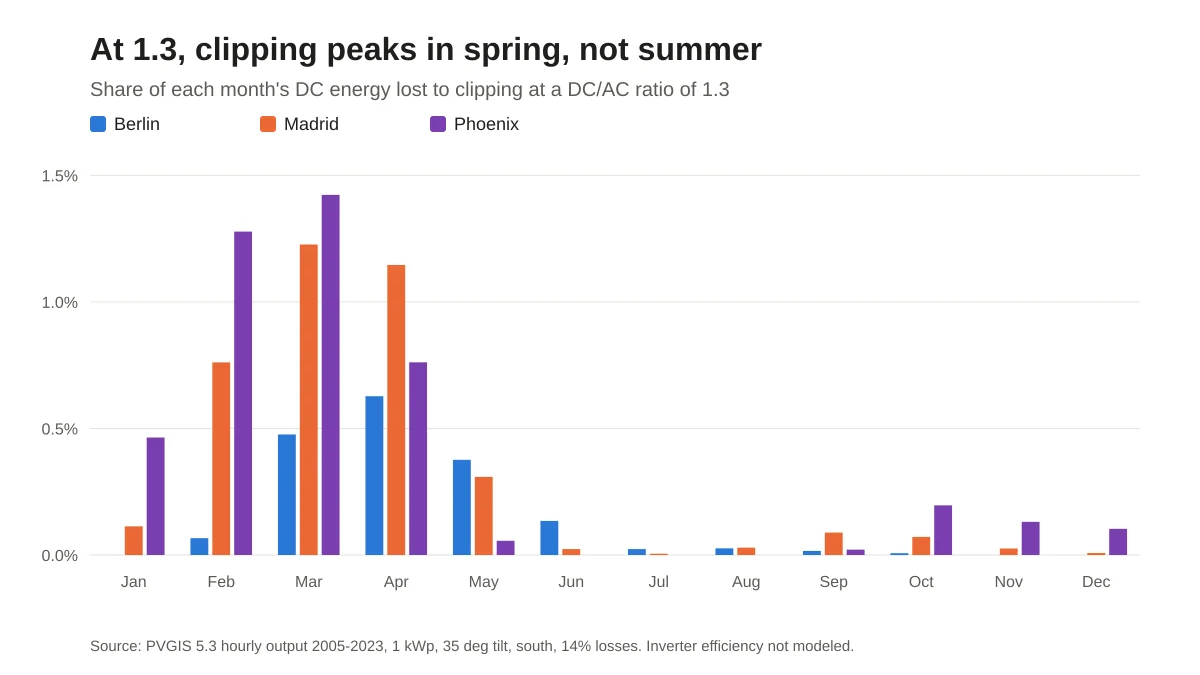
This surprised me. At a 1.3 ratio, Madrid's worst month was March at 1.2% and its summer months were around zero. Phoenix peaked in February and March at 1.3 to 1.4%.
The reason is heat and sun angle. Crystalline silicon loses output as cells warm, and datasheets typically list a coefficient somewhere around minus 0.3 to minus 0.4% per degree C. A cool, clear March day gives you strong light on cold cells. A July afternoon gives you stronger light on cells 30 degrees hotter. Add a fixed 35 degree tilt, which faces the equinox sun closer to square-on than the high summer sun at these latitudes, and spring wins.
So if you're checking for clipping, don't wait for July. Look at the clearest, coolest day you can find.
How Do You Diagnose Clipping on Your Own System?
Start with the power curve, not the daily total. Totals hide it.
- Pick a clear day. Cloud-free from about 10:00 to 15:00, ideally cool.
- Look at the shape. A true clip is a flat plateau, not a gentle dome. Your app should show it at 5-minute or 15-minute resolution. Our guide to reading inverter data covers where to find that view.
- Read the plateau height. If it sits within a few percent of the inverter's rated AC power, that's clipping. If it's flat at a number well below the rating, something else is capping it.
- Compare with a model. PVGIS hourly output for your coordinates and tilt gives a healthy-system curve. If your real curve is lower and flat, the gap is your loss.
- Count the hours. A plateau of 20 minutes a few days a year is nothing. Three hours on most clear days is worth acting on.
Step 3 is where people get fooled. A plateau below the rated figure usually means one of these instead:
- An export limit or zero-export setting from your utility or installer.
- Grid-voltage curtailment, where the inverter backs off because your local voltage runs high.
- Heat derating, where a hot inverter in a closed cabinet cuts output on summer afternoons.
- A per-MPPT current limit. The Huawei SUN2000-6KTL-M1, for instance, lists 13.5 A per tracker, so a long string of high-current panels can hit that ceiling before the AC limit.
None of those is fixed by buying a bigger inverter. If you're unsure your system is producing what it should at all, start with checking that your panels work.
How Do You Reduce Clipping Losses?
Pick the cheapest fix that matches the cause. Roughly in order:
- Do nothing. Under about 1 to 2% yearly loss, the extra panels paid for themselves. Resist the urge to fix what isn't broken.
- Check the settings first. A misconfigured export cap looks identical to clipping and costs nothing to fix.
- Move loads to midday. Hot water, EV charging and heat pumps eat the peak instead of the inverter throwing it away.
- Add a DC-coupled battery. The surplus charges the battery before AC conversion. Our battery sizing guide covers how many kWh that takes.
- Split the array east and west. Two orientations spread the same energy over a longer day and flatten the peak, which is the whole game.
- Fit a larger inverter. Last resort, because it's the most expensive and the lost energy is the cheapest to give up.
Datasheets tell you the limits. The Fronius Primo 8.2-1, a discontinued 8,200 W inverter, lists a recommended PV power of 6,600 to 12,700 W. That's a DC/AC range of about 0.80 to 1.55, so Fronius itself considers 1.5 normal for that model. If you're comparing brands before sizing, our Fronius vs SMA string inverter comparison is a good place to start.
Chasing zero clipping is a mistake: at a DC/AC ratio of 1.3 the loss is under half a percent, and the oversizing that causes it is what makes the system pay back.
Does Clipping Matter More on Large Commercial Roofs?
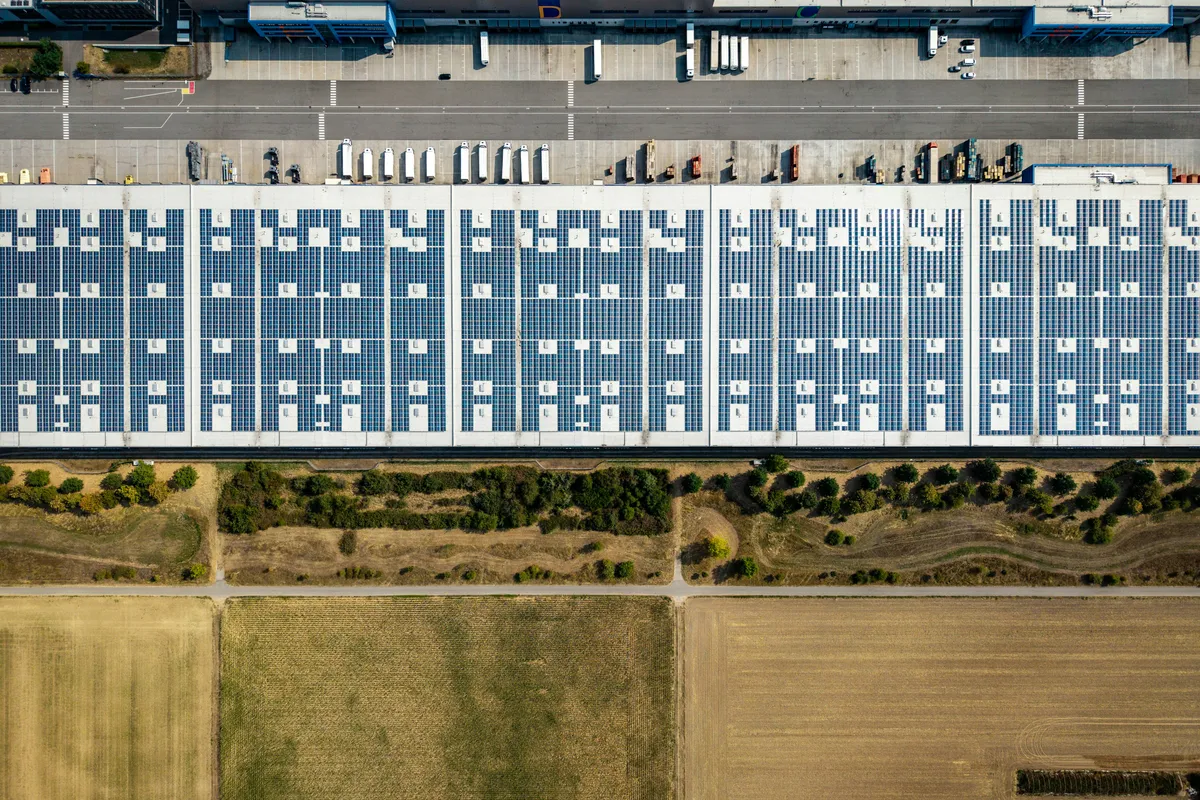
The physics doesn't change, but the economics do. A big flat roof has a lot of identical panels at one orientation, which makes the production peak sharp and tall. Developers often size commercial arrays above 1.3 on purpose, because inverter capacity and grid connection fees are priced per kW, and the energy they give up is the least valuable of the day.
What Are the Limits of These Numbers?
Three, and they all push the real-world loss up, not down.
First, PVGIS gives hourly averages. A real inverter sees minute-to-minute swings, including the brief boost when sun breaks through cloud edges, so it clips more than an hourly model shows. Second, I didn't model inverter conversion efficiency, which is typically 97 to 98% at the top end and slightly changes where the cap bites. Third, I used one orientation: south, 35 degrees, 14% losses. A different tilt or heavier shading shifts every figure.
Treat the table as a floor. If your metered plateau is longer than the model suggests, your real loss is a bit higher than my percentages.
The scripts are in examples/solar-clipping-model/ in the repo if you'd like to rerun them with your own coordinates.
Summary
Clipping is the inverter discarding DC power above its AC rating, and it's controlled by the DC/AC ratio. In 19 years of modeled data for Berlin, Madrid and Phoenix, a ratio of 1.3 lost 0.19 to 0.39% of yearly energy, while 1.6 lost 3.35 to 6.06%. Losses peak on cool, clear spring days, not in summer. Diagnose it by looking for a flat plateau at the inverter's rated AC output on a clear day, and rule out export caps, voltage curtailment and heat derating before blaming the sizing. Under roughly 1 to 2% yearly loss, leave it alone.