

Four checks answer this, in order of how fast they are: the inverter status light, this month against the same month a year ago, the utility meter on a sunny noon, and your annual total against the installer's year-one estimate. The first takes ten seconds. The last one catches the failures the other three miss.
TL;DR: A green or solid inverter light means the system is running, not that it's running well. Compare generation to the same calendar month last year, never to last month, because seasonal swing is bigger than most faults. Watch the utility meter at midday with big loads off. Then check the annual total against the year-one estimate on your contract; more than 10 percent short is worth a call.
Panels don't announce their own failure. A single dead string keeps the inverter online, the app still shows a graph, and the only symptom is a bill that crept up.
Check One: What Is the Inverter Telling You?
The inverter is the only part of the system that reports on itself. Find it, usually in the garage or on an outside wall, and look at the status indicator.
| What you see | What it means | What to do |
|---|---|---|
| Solid green, or a normal-state icon | Producing and exporting | Nothing |
| Flashing green or amber | Starting up, or in a reduced state | Recheck in an hour of daylight |
| Red, or an error code | Fault, grid problem or shutdown | Note the code, then call |
| Nothing at all, at midday | No DC input, or the inverter is dead | Call the installer |
A blank screen at noon on a clear day is the one unambiguous failure signal on this list. Everything else needs a second data point before you can call it.
Worth knowing: your inverter shuts itself down during a grid outage, by design and by code, unless you have specific backup hardware. That's an anti-islanding rule protecting line workers, not a fault. Our guide on reading solar inverter data unpacks what the rest of the numbers on that screen mean.
Check Two: Compare Against Last Year, Not Last Month
This is where most people get it wrong. December output can be less than half of June output on the same roof, so a month-over-month drop tells you about the calendar, not about your panels.
Open your monitoring app and pull up the same calendar month from a previous year. Sun angle, day length and typical weather all roughly hold. Now the comparison means something:
- Within about 5 percent: normal, including a year of expected degradation
- Down 10 to 15 percent: soiling, new shading, or one underperforming string
- Down 25 percent or more: a string or an MPPT channel is likely offline
Panels themselves degrade slowly, around 0.5 percent a year by the NREL fleet median, so genuine ageing never explains a double-digit drop. Something else does. Tree growth is the most common culprit nobody suspects, because it happens over years and nobody photographs their roofline in spring.
Check Three: Watch the Meter at Midday
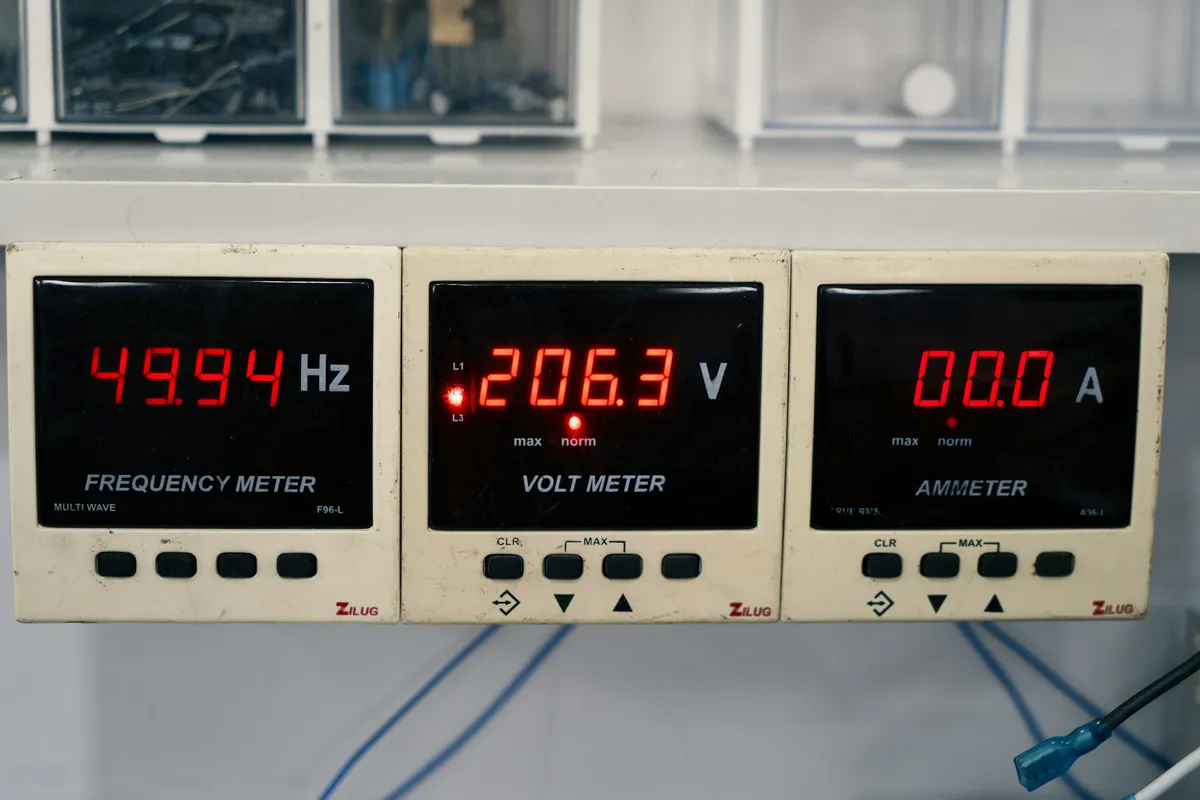
No monitoring app? The utility meter still works as a crude instrument. Pick a clear day near noon, switch off the big loads, and watch the display. A bidirectional meter should show export, or a net figure that stops climbing.
That test proves AC is reaching the panel and flowing the right way, which is more than the inverter light proves on its own. It won't tell you whether you're producing 6 kW or 3 kW, so treat it as a pass or fail, not a measurement.
Check Four: The Number on Your Contract
Every reputable installer supplies a year-one production estimate, in kWh, before you sign. That's the number your system is actually accountable to, because it already accounts for your pitch, orientation and shading. Most people never look at it again.
For a rough sanity check without the paperwork: US mid-range yield runs about 1,400 kWh per installed kW per year, so an 8 kW array should land near 11,200 kWh. Cloudy states run closer to 900 per kW, the desert southwest closer to 1,750.
What's the shortfall actually costing? At the 18.16 cents per kWh US households averaged over the first half of 2026 (EIA), a 15 percent gap on an 11,200 kWh system is about $305 a year. Quietly, every year, until someone checks.
I'd put an annual reminder in the calendar for this one. It's fifteen minutes in January, and it's the only check that catches slow decline rather than sudden failure.
When the Answer Is No
If two or more checks fail, stop diagnosing and call the installer while the workmanship warranty still applies. Note the inverter error code, the month-on-month-last-year figures, and the date you first noticed. That turns a vague complaint into a service ticket someone can act on.
If the panels are visibly damaged, cracked glass, browning, or a scorched junction box, our damage identification guide covers what's a warranty claim and what's an insurance one.
Summary
Working and working properly are different questions. The inverter light answers the first in ten seconds. Only the year-on-year comparison and the contract estimate answer the second, and those are the ones that catch a dead string quietly costing you a few hundred dollars a year. Check the light whenever you walk past it, and check the numbers every January.