

Does winter wear a home battery out? Mostly no. It does two other things, and the second one is the one that costs you energy.
First, it shrinks the amount you can draw. Second, below a temperature each maker prints on its own datasheet, it stops the pack from charging. A battery that can't charge at 10 a.m. on a clear January day isn't degraded. It's just parked.
I haven't tested a battery for this article. What I did do is read the manuals and data sheets of five products, then run about 360 lines of Node that put their printed limits against 19 years of hourly weather in four cities. Everything below is either a number from a maker's own document or a number out of that model, and I'll say which.
Is Cold Weather Degradation or a Temporary Tax?
A temporary tax, with one permanent exception. That exception is charging below freezing.
Battery University's page on cold charging says it plainly: when a lithium-ion cell is charged below freezing, metallic lithium plates onto the anode, causing permanent loss of performance and a safety risk, and the pack may look as if it's charging normally. The same page lists the usual charge range as 0 C to 45 C. Discharging in the cold, by contrast, only reduces what you get, and the page notes that the reduced capacity recovers at room temperature.
So the useful split is this:
- Cold discharge: less energy and less power available, reversible, no damage.
- Cold charge: blocked by the battery management system, or heated first. Forced through, it's permanent.
- Heat: the one that really ages the cells. Different article, covered in the battery sizing guide.
Which means "degradation in the cold" is the wrong frame for a solar owner. The right question is how many sunny winter hours your battery will refuse. The model below answers that for four places.
What Do the Datasheets Say, Brand by Brand?
Here are the limits as printed. I opened each document; where a product page was silent, the cell says so.
| Product | Charging allowed | Discharging allowed | Heater | Source |
|---|---|---|---|---|
| Victron Lithium Smart (LiFePO4) | +5 to +50 C | -20 to +50 C | none in the manual | manual rev 21, 01/2026 |
| Anker SOLIX C2000 Gen 2 | 0 to 40 C | -20 to 40 C | none stated | product page |
| EcoFlow DELTA Pro 3 | 0 to 45 C | -10 to 45 C | not stated for this model | FAQ page |
| Enphase IQ Battery 5P | -20 to 50 C ambient | -20 to 55 C ambient | none documented | data sheet, March 2025 |
| Tesla Powerwall 3 | -20 to 50 C ambient | -20 to 50 C ambient | yes, cell-level resistive | 2026 data sheet, Heat Mode white paper |
Two notes before you read anything into that table.
The Enphase sheet also gives an optimum operating range of 0 C to 30 C, and its footnote 8 assures full charging current only from 15 C up to 45 C. Tesla's 13.5 kWh is, per its own footnote, the minimum guaranteed at beginning of life, at 25 C and 5 kW. None of these numbers is a winter measurement. Mine, either, since I haven't measured a battery.
And "-20 C" in the Enphase and Tesla rows is an ambient figure, while Victron's 5 C is a cell figure, because its battery manages charging from its own temperature reading. The pack inside a warm hallway and the pack on a north wall are the same product with very different days.
How Much Capacity Does LiFePO4 Lose in the Cold?
Victron is the only maker in this set whose documents print a capacity-by-temperature curve. Its data sheet gives, for a 100 Ah battery at discharge currents up to 1C, 100 Ah at 25 C, 80 Ah at 0 C and 50 Ah at -20 C. The manual repeats it in words: reduced by about 20% at 0 C and by about 50% at -20 C. It adds a warning I'd pin above any battery: because state of charge is calculated in the battery monitor and not in the battery, the percentage on screen isn't the real figure in the cold, so watch cell voltages instead.
What does that mean for a pack that sits outside? I applied Victron's three points, linearly interpolated, to every hour of 19 winters with zero solar output, so nights. A bare LiFePO4 pack at air temperature would have these usable fractions on a December-to-February night:
| City | Mean usable capacity | Night hours at or below 0 C | Night hours below -20 C |
|---|---|---|---|
| Berlin | 80% | 37% | 0.1% |
| Oslo | 74% | 74% | 0.7% |
| Boulder | 69% | 88% | 2.1% |
| Minneapolis | 64% | 87% | 7.9% |
Minneapolis is the useful case. A 10 kWh pack that behaves like Victron's would give about 6.4 kWh on an average winter night there. To actually deliver 10 kWh you'd need 15.6 kWh nominal. That's my arithmetic on one product's curve, not a promise from any seller, and a heated or indoor pack breaks it completely.
Is LiFePO4 Worse Than NMC in the Cold?
I went looking for a clean answer and didn't find one. Web search turned up industry posts that disagree about which chemistry holds up better, and none that I could trace to a dataset, so I left them out.
What I could open: Battery University says a battery delivering 100% at 27 C typically gives about 50% at -18 C, without naming a chemistry. Samsung SDI's spec for its INR21700-50E, a nickel-based cell, lists 70% of its 4,900 mAh standard capacity at -10 C against 97% at 23 C, both at 1C, which is 72% of itself. Victron's interpolated figure at -10 C is 65%. Different formats, different currents, one cell against one module.
That's inside the noise. My read: chemistry isn't the cold decider for a house battery. The charging floor is about 0 C for both families, and the heater, the wall and the maker's BMS settings decide the rest. LiFePO4 wins home storage on cycle life and safety, which is a separate argument. Disagree if you have bench data; I'd like to see it.
Where Does the Charging Limit Actually Bite?
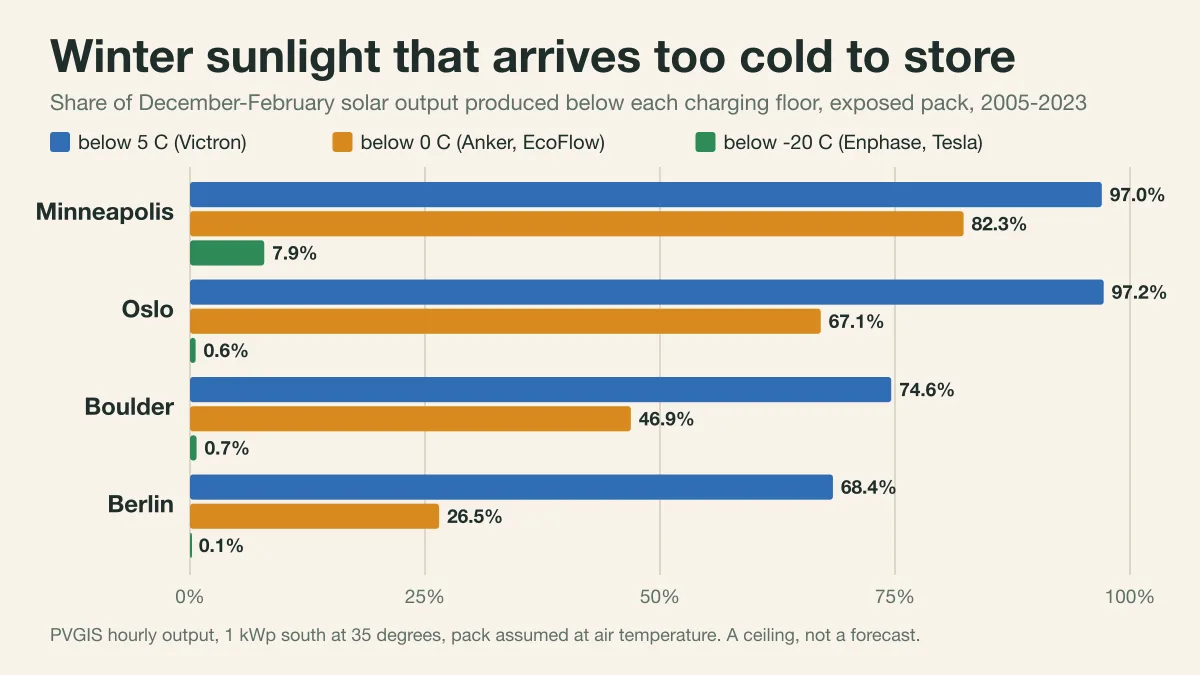
I took PVGIS 5.3 hourly output for a 1 kWp array facing south at 35 degrees in Berlin, Oslo, Boulder and Minneapolis, 2005 to 2023, and the 2 m air temperature that ships in the same rows. For each product's printed charging minimum I added up the output produced in hours colder than that. It's a ceiling: the house uses some of that sunshine directly, and the pack never needed all of it.
| Charging floor (products) | Berlin | Oslo | Boulder | Minneapolis |
|---|---|---|---|---|
| Below 5 C (Victron) | 68% | 97% | 75% | 97% |
| Below 0 C (Anker C2000 Gen 2, EcoFlow DELTA Pro 3) | 27% | 67% | 47% | 82% |
| Below -20 C (Enphase 5P, Powerwall 3) | 0.1% | 0.6% | 0.7% | 7.9% |
Those are shares of December-to-February output. Over a full year the same floors capture 12 to 33% of output at 5 C, 4 to 23% at 0 C, and under 2% at -20 C. Winter only supplies 7% of Oslo's annual energy and 20% of Minneapolis's, so a locked-out January stings less in the annual total than it does in the month.
It was the 5 C row that surprised me. With Victron's default, a bare pack in Oslo or Minneapolis sees about 97% of its winter sun arrive too cold to take.
In Minneapolis, 82% of winter sunshine arrives below 0 C, the charging floor of two popular portable batteries, and only 8% below the floor of a Powerwall 3.
How Many Whole Days Does the Pack Sit Out?
Hours below a floor matter less than days where the afternoon never climbs above it, because those are the days an unheated pack gets no second chance.
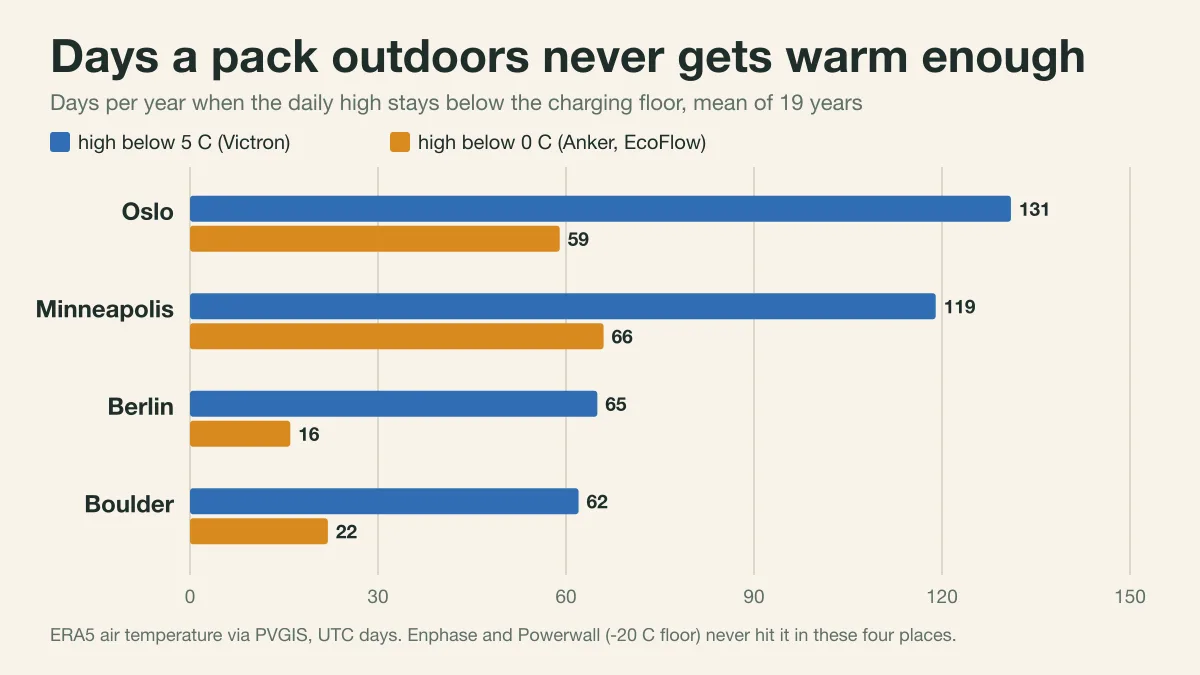
Oslo logs 59 days a year with a daily high under 0 C, Minneapolis 66, Berlin 16, Boulder 22. At Victron's 5 C floor it's 131, 119, 65 and 62. Add the discharge side: the EcoFlow's -10 C discharge minimum sits below the air temperature for about 827 hours a year in Minneapolis and 304 in Oslo, against 157 and 14 hours under -20 C for the others.
Boulder's numbers deserve a footnote. ERA5 is a grid, not a thermometer, and I haven't checked what elevation Boulder's cell averages; its mean annual low of -26 C may be colder than a thermometer in town would read, so I'd treat it as the cold end. The same goes for every city here, which is why I'd call the results a ceiling.
Do Built-In Heaters Fix It?
For one product in this set, documented and cheap. For the others, not documented.
Tesla's Heat Mode white paper describes dedicated resistive heating elements on every Powerwall 3 cell. Its table of cell temperature against behavior is worth quoting in shape: above 10 C charging and discharging are normal; between 0 and 10 C charging is limited; between -20 and 0 C charging is not available and discharging is limited; below -20 C neither works. Heat Mode's job is to hold the cells at 0 C or higher, and to heat ahead of expected solar so charging can start when the sun does. A pack commissioned in the cold heats at an average of 6 to 7 C per hour, and at -20 C ambient Heat Mode typically uses about 200 Wh to prepare the cells for the day's charge.
I multiplied that 200 Wh by every day a year with a sub-zero low, for an assumed 8 kWp array. The answer is 14 kWh a year in Berlin, 27 in Oslo, 32 in Boulder, 27 in Minneapolis: between 0.17% and 0.37% of the array's output. It's a ceiling only in the sense that I charged the -20 C figure to milder days; it's a floor in another sense, because Tesla's number covers preparing the cells for charging and the paper also says the system holds 0 C for discharge. Take it as the right order of magnitude, nothing finer.
Two limits Tesla states itself: below -20 C ambient the heaters may not keep up, and a pack that can't heat enters a deep sleep for up to 30 days, and Tesla says not to install one outside where daily highs are commonly under -20 C. The fleet histogram in the paper is Tesla's own, 100 sites across Colorado, Utah, New York, New Jersey, Connecticut and Massachusetts in February 2024. It isn't independent evidence.
What about the rest?
- Enphase IQ Battery 5P: the data sheet lists passive cooling with natural convection and no heater, and charging from -20 C ambient. Its footnote 8 adds that charging and discharging currents are only guaranteed not to be de-rated within 15 to 45 C while charging and 5 to 50 C while discharging. So between -20 C and 15 C the pack charges, but at a current Enphase doesn't quantify. I found no published derating curve for that range; ask your installer for it.
- Anker SOLIX C2000 Gen 2: the page prints 0 C charging. Anker's cold-weather post says to warm the unit to at least 0 C in a dry place before connecting a charger, and doesn't describe a heater.
- EcoFlow DELTA Pro 3: FAQ says 0 C charging, -10 C discharge. EcoFlow's sub-zero article claims high-end models warm their own battery with stored power but names no model, wattage or threshold, so I can't say it applies here.
- Victron Lithium Smart: the BMS turns chargers off on low temperature, and the Allowed-To-Charge minimum is a setting, default 5 C, adjustable down to -20 C. The manual says cells take permanent damage charged below 5 C and that setting it lower voids the warranty.
What Do the Warranties Say?
Not much about cold, in the documents I read. That's itself the finding.
Enphase warrants the 5P to more than 60% capacity for up to 15 years or 6,000 cycles, whichever comes first. Tesla's datasheet says 10 years and requires a reliable internet connection to keep the full term. Neither page makes cold a condition, and neither gives a capacity floor by temperature. The one explicit cold-and-warranty statement I found is Victron's: charge below 5 C by overriding the limit and you've voided it.
Small print differs by country and edition, so read the warranty for your model before you rely on any of this.
Where Should the Battery Go?
My opinion, and the datasheets lean the same way: inside the insulated envelope, every time you've got the choice.
An exposed wall in Minneapolis or Oslo costs a 0 C-floor unit about 60 days a year of no charging at all, plus a winter of 64 to 74% usable capacity if it's unheated LiFePO4. An unheated garage that stays above freezing erases most of that, which the sizing guide also argues. If you can't, buy for the charging window: a -20 C ambient rating backed by documented cell heating, or a pack you can place indoors.
For portable stations it's simpler. Don't leave one in an unheated shed and plug it in. The portable power station comparison lists the charging window for the C2000 and notes the rest don't print it; bring the unit inside, let it warm, then charge. If you're sizing for a blackout, the inverter generator versus power station math starts from nameplate capacity; for a unit in a freezing garage, scale it by the usable fractions above.
What Can't This Model Tell You?
A lot, and I'd rather list it.
- Pack temperature equals air temperature. Real packs have thermal mass, warm up while working, and sit behind walls. Tesla's own paper shows cell temperature lagging ambient.
- One chemistry curve, one maker. Victron's three points stand in for "an unheated LiFePO4 pack". Other makers may differ, and a heated or insulated pack isn't covered.
- Grid-cell weather. ERA5 reanalysis, UTC days, not a station near you.
- No battery was tested. Every limit is a printed one; I haven't confirmed that any unit behaves as its sheet says.
- Unverified claims. The 15 C full-current figure for the Enphase 5P that appears in some summaries is not in the data sheet I opened, and I didn't find it elsewhere.
If you want to rerun it, the script, fetcher and raw output sit in the blog's examples/battery-cold-weather-model/ folder, and every figure in the tables above comes from its results.txt. Swap in your coordinates and your own product's printed limits. What would your winter say?