

Which one is cheaper to run when the power goes out? Most comparisons answer with weight, noise and a shrug. The fuel arithmetic is sitting in the spec sheets, and it isn't close.
I haven't tested either kind of machine for this article. Everything below comes from manufacturer pages, the EIA and a calculator, and I'll say which number is mine rather than theirs.
What do the datasheets say?
I took the two most common 1,800W inverter generators, the Honda EU2200i and the Yamaha EF2200iS, and set them against the two power stations I used in our five-datasheet comparison. Power station figures are from the product pages we fetched on 2 October; the generator pages were read on 21 October.
| Spec | Honda EU2200i | Yamaha EF2200iS | Anker C2000 Gen 2 | Bluetti Elite 200 V2 |
|---|---|---|---|---|
| Rated / max output | 1,800W / 2,200W | 1,800W / 2,200W | 2,400W / 4,000W | 2,600W |
| Stored energy | 0.95 gal tank | 1.24 gal tank | 2,048Wh | 2,073.6Wh |
| Runtime, rated load | 3.2 h | not printed | n/a | n/a |
| Runtime, quarter load | 8.1 h | 10.5 h | n/a | n/a |
| Noise | 57 dBA rated, 48 quarter | 57 to 65 dBA | not measured here | not measured here |
| Weight | 47.4 lb (21.5 kg) | 55.2 lb (25 kg) | 18.9 kg | 24.2 kg |
| Price | $1,199 | $1,199 at launch | $899.99 | $899 |
| Warranty | 3 years | 3 years | 5 years | 5 years |
Two caveats. Honda's own page refused my fetch, so the Honda numbers come from a retailer listing that reproduces its spec sheet, and that listing printed two different weights (47.4 and 52.14 lb). I used the first. And Yamaha's page doesn't print a rated-load runtime or a price, so the $1,199 is the launch figure I found quoted, not a current one.
What does a kWh cost from each?
Here's the math, step by step, so you can swap in your own gas price.
Gasoline averaged $4.284 per gallon on 19 October 2026, according to the EIA. The Honda holds 0.95 gallons and runs 3.2 hours at its 1,800W rating:
- Rated load: 0.95 gal / 3.2 h = 0.297 gal per hour, which delivers 1.8 kW. That's 6.06 kWh per gallon, or 71 cents per kWh.
- Quarter load (450W): 0.95 gal / 8.1 h = 0.117 gal per hour for 0.45 kW. That's 3.84 kWh per gallon, or 112 cents per kWh.
The Yamaha lands on the same quarter-load figure: 1.24 gal / 10.5 h at 450W is 3.81 kWh per gallon, about 112 cents.
Now the stations. The EIA puts the US residential average at 18.31 cents per kWh (the figure from our earlier post). A station loses some of that energy in the round trip. I'm assuming 80%, which is my number, not a manufacturer's, so 18.31 / 0.8 is 22.9 cents. Add the battery wear from the earlier post, price divided by capacity times rated cycles, which ran 7.2 to 13.1 cents across four units. That makes 30 to 36 cents from the wall, and 7 to 13 cents if the sun refills it.
So a generator costs roughly two to fifteen times more per kWh. Why is a quarter load worse? My reading of the runtime figures is that the engine burns fuel just to keep turning, and a light load spreads that cost over fewer watts. Keep that in mind if your outage load is a fridge and a router.
At a quarter load, one kWh from a Honda inverter generator costs about $1.12 in gasoline, three to fifteen times what a power station charges.
Where does the generator still win?
Duration. Look at what one fill-up holds:
- Honda EU2200i, one tank at rated load: 1.8 kW x 3.2 h = 5.76 kWh
- Honda EU2200i, one tank at quarter load: 0.45 kW x 8.1 h = 3.65 kWh
- Anker C2000 Gen 2: 2.05 kWh. Bluetti Elite 200 V2: 2.07 kWh.
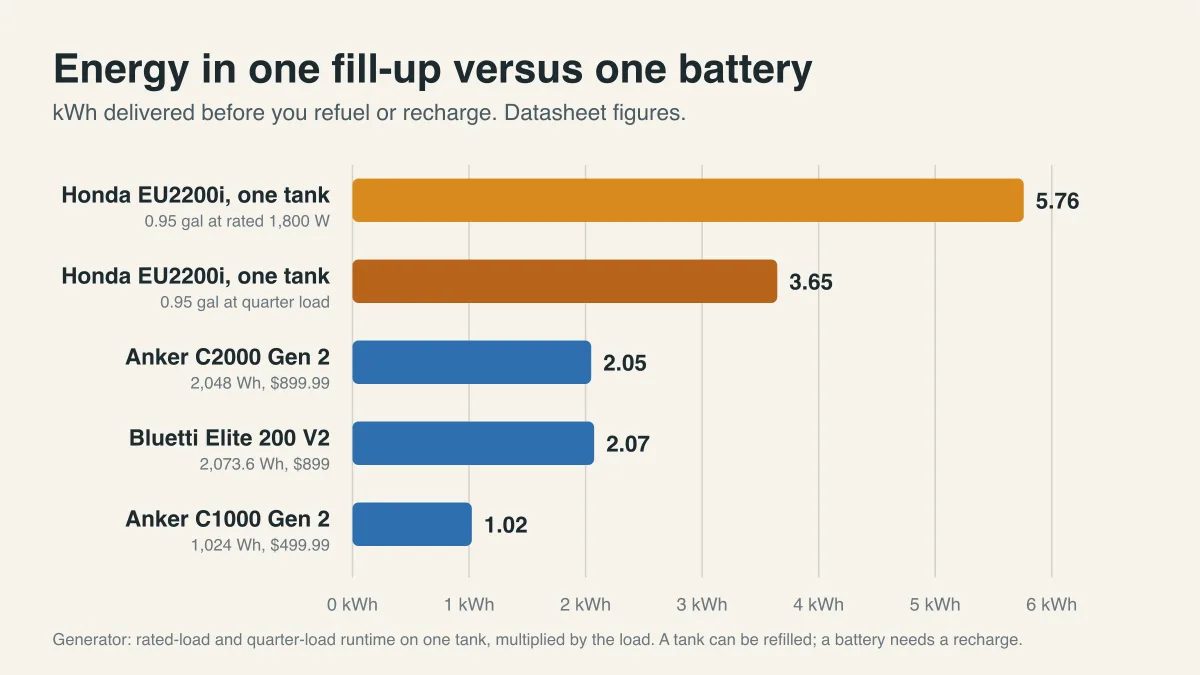
One tank beats a 2 kWh battery, and the tank can be refilled in a minute. A battery needs hours of sun or a wall outlet that isn't dead. For a three-day storm with cloud cover, that gap decides the question. Say the essentials, fridge, router, lights and chargers, average 300W. That's 7.2 kWh a day, my assumption. A 2 kWh station covers about seven hours of it. The generator covers it with a few refuels, and the gasoline bill for a day is around 3 gallons, about $12, at the quarter-load burn rate. I'm using that as a rough ceiling, since I couldn't find a lower-load figure.
Size matters too. At 2,200W peak, neither generator is a well-pump or electric-range machine, and the stations here top out at 2,400 to 2,600W. If you need more than that, you're shopping in a different class, and our sizing guide for home batteries is the better starting point.
Where does the station win?
Everywhere that you'd rather not hold a fuel can. A station makes no exhaust, so it can sit in a room. It has no oil to change and no gasoline to go stale in a carburetor; how long fuel stays good depends on the blend and the storage, and your owner's manual has the real answer. It can charge from a roof panel. And the 5-year warranties on both stations here beat the generators' 3.
It's also what I'd buy for short outages. If your longest blackout in five years was six hours, a $900 station with a fridge-and-router load is plenty, and you'll never pay a cent for fuel. Where a roof is already involved, our C2000 versus DELTA 3 Max test shows how those units behave next to a real array, and our Anker C2000 Gen 2 review covers the model used above.
My opinion, and you may disagree: for most households the right answer is the station, with a generator only if outages last days where you live. A generator you can't safely run indoors or in a garage is a bad fit for an apartment, and a station is a bad fit for a rural property that loses power for a week.
Can you power your house with a portable generator?
Yes, in two very different ways.
The simple way is extension cords from the generator to individual appliances. For a fridge, router and lamps that works with a 1,800W unit. Check each appliance's nameplate for its startup draw.
The whole-house way is through the electrical panel. Don't do that by plugging the generator into a wall outlet. That backfeeds the house and can energize utility lines, which puts line workers at risk. The correct hardware is an interlock or a transfer switch, fitted by a licensed electrician. For a larger system like that, a battery bank charged by solar is also an option; see our off-grid package comparison.
The other safety fact is carbon monoxide. The CPSC says to run generators outdoors, at least 20 feet from homes and buildings, with the exhaust pointed away from windows, doors and vents. It also advises buying a model with a CO shut-off, and says units certified to the 2023 versions of the PGMA G300 and UL 2201 standards include CO safety features. The Honda listing I read mentions a CO-Minder, which is Honda's name for that kind of sensor. I didn't verify what it does beyond the listing.
What can't this comparison tell you?
It's a paper exercise. I measured nothing, and real fuel burn varies with altitude, temperature, fuel quality and engine age. Honda's runtime figures are lab numbers, and I assumed a full tank. The 80% round-trip efficiency is mine. Gas prices move weekly, and the station prices will too. Fan noise on a station and the real startup behavior of your fridge are outside the table.
If you want to see what a generator does to the economics of a solar roof with storage, the solar payback calculator lets you test your own export rate. What does your longest outage in the last five years look like? That one number picks the machine.