optimization

Why Cleaning Solar Panels Matters for Yield Output

Dirty solar panels lose 3-25% of annual output. Learn how soiling affects yield, how often to clean by climate, and the right methods to avoid damage.

· James Whitfield · 13 min read
Technician cleaning dust and bird droppings from rooftop solar panels with a soft brush and water

Cleaning solar panels is one of the highest-return maintenance tasks available to a system owner. Research published in Renewable and Sustainable Energy Reviews found that dust accumulation without rainfall reduced panel output by up to 40% in one month in desert conditions (Maghami et al., 2016). Even in wetter climates, soiling is the second most common undetected yield loss after shading.

TL;DR: Soiling costs 3 to 25% of annual solar output, up to 40% after one month without rain in desert conditions (Maghami et al., 2016). In temperate climates with regular rainfall, you're looking at 0.2 to 1% annual loss. In arid regions like Arizona or southern Spain, that jumps to 8 to 25% without intervention. Clean panels one to four times per year depending on local dust and rainfall: once annually in wet northern climates, every two to three months in desert environments. Always use deionised or distilled water and a soft microfiber brush, never a jet washer, which can force water under frame seals and cause delamination, and never abrasive cloths, which scratch the anti-reflective coating permanently. A single dropping covering 0.5% of a panel's surface can cut that panel's output by 3 to 8% due to cell-level shading effects. Per-panel monitoring via microinverters or power optimizers catches soiling early. It's the fastest payback maintenance task in any solar system.

Honestly, the "do panels need cleaning?" debate has only one honest answer - it depends on your climate and your tilt angle. My take: most US installations need 1-2 cleanings a year; most UK installations don't need any unless something biological is growing on them.

Soiling sits alongside shading as the most actionable yield loss. Unlike panel aging or suboptimal tilt, it's fully reversible with a cleaning visit. Understanding exactly what dirty panels cost, and how to avoid common cleaning mistakes that cause permanent damage, is the starting point for any maintenance plan. For a broader look at how to increase your solar PV yield, soiling management is consistently one of the first levers worth pulling.

How Much Output Do Dirty Solar Panels Actually Lose?

The IEA PVPS Task 13 report found that soiling causes 3-5% of global annual PV energy production loss, with extreme regional variation that makes a single headline figure misleading (IEA PVPS T13-21:2022, 2022). A comprehensive European-scale assessment found Norway averages just 0.2% annual soiling loss while Spain reaches up to 14% in dry scenarios, with a continent-wide range of 0.9-5.3% (Fernandez Solas et al., Renewable Energy, 2025).

The loss mechanism is straightforward. Dust, pollen, and fine particulate settle onto panel glass and block incoming irradiance. Every percentage point of surface coverage translates directly into reduced electricity output. What makes soiling insidious is its gradual pace, a panel losing 0.5% output per week looks like normal weather variation in a string-level dashboard until the cumulative loss becomes hard to ignore.

Bird droppings are a special case. Unlike uniform dust films, droppings form small opaque patches that create cell-level hot spots. A single dropping covering just 0.5% of a panel's active area can reduce that panel's output by 3-8% because of how partial shading interacts with cell strings. That's a loss roughly ten times larger than the physical coverage area suggests.

Annual Soiling Loss by Climate Zone (%) 0% 10% 20% 30% Arid / Desert 8-25% Mediterranean 3-8% Temperate (mod. rain) 1-3% Temperate (high rain) 0.2-1% Near industry/farms +2-5% extra Sources: IEA PVPS Task 13 (2022), Fernandez Solas et al. Renewable Energy (2025) NREL Soiling Technical Report (2018)

Citation capsule: A 2025 study in Renewable Energy by Fernandez Solas et al. analysed soiling losses across European PV systems and found annual losses ranging from 0.2% in Norway to 14% in dry Spanish scenarios. The continent-wide average fell between 0.9% and 5.3% depending on rainfall effectiveness, with arid southern climates 10-70 times more exposed than northern ones. (Fernandez Solas et al., Renewable Energy, 2025)

How Does Climate Determine Your Cleaning Schedule?

Cleaning frequency is not one-size-fits-all. The right interval depends on three factors: average annual rainfall, particulate sources near your site, and panel tilt angle. The table below gives starting-point guidance, your own monitoring data should refine these intervals over time.

Climate ZoneExamplesTypical Annual Soiling LossRecommended Cleaning Interval
Temperate, high rainfallUK, Scandinavia, Pacific Northwest0.2-1%Once per year
Temperate, moderate rainfallCentral Europe, NE United States1-3%1-2 times per year
Mediterranean / semi-aridSouthern Europe, California, Chile3-8%Every 3-4 months
Arid / desertArizona, Middle East, N. Africa, W. Australia8-25%Every 4-8 weeks
Near agricultural or industrial sitesAny region near farms, motorways, airportsAdd 2-5% extra lossAdd 1-2 extra cleanings/year

Sources: NREL soiling technical report (2018), IEA PVPS Task 13 (2022), Fernandez Solas et al. (2025)

Panels tilted below 10 degrees are a separate problem. Water pools rather than sheets off, leaving mineral deposits when it evaporates. Sandia National Laboratories' soiling station research found flat-mounted panels accumulate hardened residue even in climates with regular rainfall (Sandia National Laboratories, 2019). If your system is roof-flat or low-tilt, add at least one extra cleaning cycle per year compared to a steeply pitched equivalent.

Pollen season deserves specific attention. In spring, heavy pollen deposits can add 2-4% loss within a few weeks in temperate climates. A single cleaning timed after peak pollen drop, typically May or June in the Northern Hemisphere, recovers that loss before summer's highest-irradiance weeks.

Cleaning is just one pillar of a complete solar system optimization strategy. The other pillars, MPPT configuration, shading management, and monitoring, all interact with how you interpret soiling-related data.

What Is the Right Way to Clean Solar Panels?

The right cleaning method removes soiling without scratching the anti-reflective glass coating or causing thermal shock. NREL's soiling research recommends using deionised or distilled water whenever possible, since tap water leaves calcium and magnesium deposits that can be worse than the original soiling (NREL, 2018). For most residential systems, the following approach works well.

Step 1, Choose the right time. Clean in early morning or evening when the panels are cool. Cold water on sun-heated glass (panels can reach 70-80 degrees C in summer) can cause micro-cracks in the glass or cells through thermal shock. Morning also means less evaporation, so you get more cleaning time before water dries and leaves streaks.

Step 2, Rinse first. A gentle rinse with a low-pressure hose dislodges loose particulate without scratching. Let the initial rinse run for 30-60 seconds before scrubbing.

Step 3, Soft brush or microfiber cloth. Use a long-handled brush with soft bristles, or a microfiber squeegee pole. Move from the top of the panel downward so dislodged debris doesn't redeposit on already-clean areas.

Step 4, Final rinse with deionised water. A final pass with deionised or distilled water removes the mineral residue that tap water leaves. For residential systems, a small deionised water tank and pump kit costs $30-60 and pays back in avoided deposit buildup within a year or two.

What Not to Do When Cleaning Solar Panels

A few common mistakes cause more harm than leaving the panels dirty.

  • No high-pressure jet washers. Pressure washers can drive water under panel frame seals, causing delamination and long-term moisture ingress. They can also chip cell edges if aimed at the panel junction.
  • No abrasive pads or scouring cloths. Even light abrasion scratches the anti-reflective coating, permanently increasing surface reflectance and reducing output by 1-3%.
  • No household detergents. Most detergents contain surfactants that leave residue films, and many contain mineral compounds that cause the very deposits you're trying to remove. Use only plain water or a purpose-made solar panel cleaner.
  • No cleaning during strong sun. Hot panel glass plus cold water is a recipe for micro-cracking from thermal differential.
  • Don't walk on panels. It seems obvious, but worth stating: panels are not rated for foot traffic. Cell cracking from mechanical pressure may not be visible but will reduce output and can void warranties.

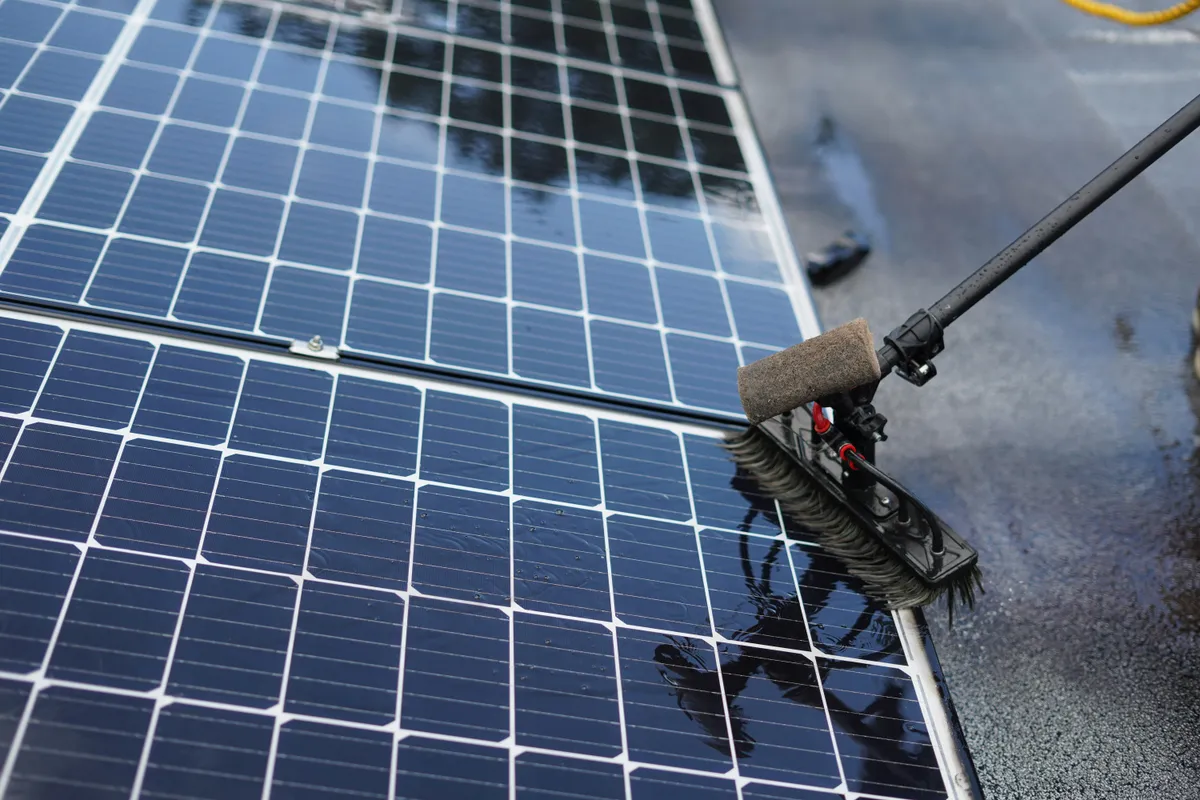
The actual cleaning process looks straightforward when you see it done right. A technician stands at the roof edge with a telescoping brush, soft bristles, about 3 meters extended, and works each panel from top to bottom in slow, overlapping strokes. A second person on the ground feeds a low-pressure hose up to rinse ahead of the brush. The whole array on a typical 6 kW residential system takes roughly 60-90 minutes this way. No ladders propped against panels, no pressure washers, no detergent bottles in sight. It's about as low-tech as solar maintenance gets, and that's the point.

Professional Cleaning vs DIY, When Does Each Make Sense?

When Is DIY Cleaning Appropriate?

Ground-mounted arrays and low single-story rooftop systems are good candidates for DIY cleaning. If you can safely reach the panels from a standing position or with a long-handled tool without ladder work, self-cleaning is practical. Annual DIY cleaning on a 6 kW system takes about 90 minutes and costs under $10 in water and supplies.

When Should You Hire a Professional?

Systems on multi-story buildings, steep pitches, or tiled roofs where safe access requires harness equipment should be cleaned by a professional with appropriate fall-arrest gear. The cost of a professional solar panel cleaning visit typically runs $150-350 for a residential system, depending on array size and access difficulty. In dry climates where cleaning is needed 3-4 times per year, a maintenance contract with a local specialist is usually more economical.

Professional cleaning services also have access to purified water fed systems, deionised water delivery at reach pole length, which leaves no mineral residue. This is the most effective method for desert-climate systems where water mineral content is high.

How Do You Detect Dirty Panels Before Losses Compound?

You don't have to wait for a visible dust layer to catch soiling, monitoring data shows it first. The key signal is a consistent gap between your actual daily output and the forecast for your location and system size. A gap of more than 5% that isn't explained by cloud cover or seasonal variation points to soiling, shading, or a panel fault.

Per-panel monitoring narrows this further. Systems using microinverters or DC power optimizers report output at the individual panel level. If one panel on a clean roof face is producing 15% less than its neighbors, a bird dropping or localised dust patch is the likely culprit. The Enphase IQ8A microinverter reports per-panel production data to the Enphase Enlighten app in real time, making it possible to identify a dirty panel within hours of a soiling event rather than after weeks of compounding loss.

String-level systems require a different approach. Compare week-on-week production with weather-adjusted forecasts, and schedule a visual inspection whenever output drops more than 5% from the prior week without a corresponding weather explanation. Some inverter platforms, SMA Sunny Portal, Fronius Solar.web, provide automatic anomaly alerts that can be configured to flag exactly this pattern.

Citation capsule: NREL's 2018 soiling technical report found that tap water used for panel cleaning can leave calcium and magnesium deposits that degrade transmission over subsequent cycles, recommending deionised or purified water for effective cleaning in hard-water regions. The report also confirmed that panels below 5 degrees tilt accumulate residue even in climates with 600-900 mm annual rainfall due to water pooling rather than sheeting. (NREL, 2018)

Soiling losses are separate from panel aging, though they interact with it. Panels that are regularly dirty run hotter than clean panels, reduced irradiance absorption reduces the thermal load, but soiling-related hot spots around bird droppings can locally accelerate cell degradation. For the full picture on how solar panels age over time, see our guide on old solar panels. Cleaning fits into a broader annual maintenance routine alongside inverter checks and visual inspections, the complete schedule and what each task actually prevents is covered in our solar panel maintenance guide.

Does Soiling Affect All Panel Technologies Equally?

Not quite. Panel surface texture and anti-reflective coating design affect how readily dust adheres and how well rain washes it off. Glass-glass bifacial panels, now common in TOPCon and HJT designs, have smoother rear surfaces that shed dust more readily than traditional backsheet panels. Some manufacturers apply hydrophilic anti-soiling coatings to front glass that cause water to sheet off in a thin film rather than beading, carrying more particulate with it.

Textured or micro-structured anti-reflective coatings that boost light capture in clean conditions can trap fine dust more readily. Laboratory testing by NREL found that panels with deeper surface texture showed 12-18% higher soiling accumulation rates per unit time than smooth-glass panels in the same environment, partially offsetting their clean-condition efficiency advantage in dusty climates (NREL, 2018).

The practical takeaway: if you're buying panels for a dusty or semi-arid climate, ask manufacturers specifically about the soiling resistance of their front glass coating. Some brands, including LONGi and JinkoSolar, publish soiling test data for their premium lines. This is a minor factor compared to cleaning frequency, but worth considering at the specification stage.

Most soiling discussions focus on total annual loss, but the timing of soiling within the year matters as much as the annual average. A 5% soiling loss in January (low irradiance) costs far less energy than the same 5% loss in June or July when irradiance is 3-4 times higher. Scheduling cleaning before peak summer months, not just tracking annual averages, maximises the energy value of each cleaning visit.

Summary

Cleaning solar panels is one of the simplest, highest-return maintenance tasks available to system owners. Soiling costs between 0.2% and 25% of annual output depending on climate, with arid regions most exposed and temperate high-rainfall regions least affected. The correct approach, soft brush, deionised water, cool panels, no pressure washers, no abrasives, takes under two hours for a residential system and fully restores soiling-related losses. Per-panel monitoring via microinverters or power optimizers catches localised dirty panels within hours rather than weeks. Pair a climate-appropriate cleaning schedule with regular forecast-vs-actual monitoring checks, and soiling becomes a managed, predictable maintenance task rather than a silent energy drain.

Frequently Asked Questions

How much output do dirty solar panels lose?
Soiling losses vary widely by climate. In temperate Northern European climates with regular rainfall, annual losses average 0.2-1%. In arid regions, Arizona, Spain, the Middle East, soiling can cost 15-25% of annual output without intervention. A 2016 Renewable and Sustainable Energy Reviews study found that a single month of dust accumulation without rain reduced panel output by up to 40% in desert conditions.
How often should solar panels be cleaned?
Cleaning frequency depends on your climate. In wet northern climates (UK, Scandinavia), annual professional cleaning is typically sufficient. In Mediterranean and arid climates, clean every 3-6 months. In desert environments or near airports and farmland, every 2-3 months may be necessary. Bird activity near your array warrants targeted spot cleaning as needed, since droppings cause concentrated losses disproportionate to their coverage area.
Can I clean solar panels myself?
Yes, with precautions. Use a soft microfiber cloth or long-handled brush with deionised or distilled water. Clean in the early morning or evening when panels are cool, thermal shock from cold water on hot glass can micro-crack cells. Never use abrasive pads, high-pressure jet washers, or detergents with mineral content. If panels are on a steep or high roof, hire a professional rather than risk a fall.
How do I know if my panels need cleaning?
Compare your actual daily output against your forecast from PVGIS or PVWatts. A consistent 5-15% underperformance gap that is not explained by weather or shading usually points to soiling. Per-panel monitoring, available through microinverter or power optimizer systems, identifies specific dirty panels by flagging individual modules producing less than their neighbors on the same roof pitch.
Does rain clean solar panels effectively?
Light rain often does not clean panels, it may wet dust and leave mineral deposits when it evaporates, creating a hardened residue worse than dry dust. Heavy rainfall with wind on panels above 15 degrees tilt is effective at removing loose particulate. Studies show panels below 5-10 degrees tilt accumulate residue even in rainy climates because water pools rather than sheets off. Manual cleaning is always more effective than relying on rain alone.

Sources