

If you read the headlines this year, you'd think net metering was being torn up everywhere. It wasn't. Most of the 2026 activity was studies, proposals and successor programs with start dates in 2027 or later. A handful of states actually decided something, and a couple of the decisions went the opposite way from what utilities asked for.
That matters because export compensation decides more of your payback than the panels do. So I went through the regulator orders, the court rulings and the quarterly tracking reports, kept only what had a date and a document behind it, and then built a small model to show what a lower export rate does to the money.
How Much Net Metering Activity Was There in 2026?
A lot of motion, not much final action. The NC Clean Energy Technology Center tracks every distributed solar policy move in its quarterly "50 States of Solar" series, and its three 2026 executive summaries tell the story in numbers:
| Quarter | Total actions | DG compensation or net metering actions | States involved |
|---|---|---|---|
| Q1 2026 | 253 | 61 | 44 plus DC and Puerto Rico |
| Q2 2026 | 284 | 53 | 45 plus DC and Puerto Rico |
| Q3 2026 | 221 | 47 | 42 plus Puerto Rico |
Compensation rules were the single biggest category in every quarter. Sounds dramatic, right? But an "action" in that count includes a bill that passed one chamber or a docket that opened, so the totals overstate how much actually changed on a customer's bill. The Q2 2026 executive summary is the most useful of the three, because that's the quarter Virginia, Maryland and Connecticut moved.
Which States Made Real Net Metering Decisions in 2026?
Here's the short list. Each row is a decision or ruling with a date, not a proposal.
| State or utility | Old rule | New rule | Effective date | Source |
|---|---|---|---|---|
| Virginia (Dominion) | NEM 1.0: annual netting, surplus credited at avoided cost | NEM 2.0: annual netting kept, 30-minute measurement interval, surplus credit $0.05829/kWh, $1/month admin charge | Final order April 30, 2026; clarified May 20, 2026; revised tariff to follow | Virginia SCC, PUR-2025-00079 |
| California (IOUs) | Net billing tariff since April 15, 2023, challenged in court | Court of Appeal upheld net billing on remand; 2026 Avoided Cost Calculator adopted | Ruling March 9, 2026; ACC Resolution E-5476 adopted October 8, 2026 | Court of Appeal A167721; CPUC |
| Maryland | Net metering capped at 3,000 MW | HB 1532 orders a successor with a lower compensation rate and a 6,000 MW combined cap | Successor by the earlier of July 1, 2027 or the 3,000 MW cap | NCCETC Q2 2026; Maryland Chapter 353 |
| Connecticut | RRES and NRES programs set to expire in 2027 | Public Act 26-127 extends programs through 2035 and orders successor programs | Signed July 2026; NCCETC reports successors due by April 2028 | Governor's office; NCCETC Q2 2026 |
| Colorado Springs Utilities | kWh net metering with monthly rollover, systems up to 120% of use | Choice of grid access charge with time-of-day net billing, or a demand charge; systems up to 200% | Approved 2026; new agreements from April 1, 2027; existing customers move April 1, 2032 | Colorado Springs Utilities |
| Arizona (APS) | Solar-specific grid access charge, about $2 to $3 a month | Charge vacated by the Court of Appeals; rehearing denied | June 16, 2026; reconsideration denied October 30, 2026 | KJZZ, Arizona Court of Appeals |
| Rhode Island | Net metering and REG program unchanged | Executive Order 26-01 ordered a cost review; no new tariff yet | Order February 9, 2026; behind-the-meter review due October 2026 | Governor of Rhode Island; NCCETC Q1 2026 |
Notice what's missing? Idaho Power, Utah, North Carolina and California's switch to net billing all happened before 2026, so they aren't 2026 changes even though installer blogs keep listing them as news. Puerto Rico's net metering is still frozen by Act 10-2024 while the Financial Oversight and Management Board fights it in court, and I couldn't find a 2026 ruling that resolved that.
What Did Virginia Decide for Dominion Customers?
Virginia is the year's surprise. Dominion asked to move new customers from annual netting to real-time netting with a lower export credit, the same direction California went in 2023. The State Corporation Commission said no.
The May 20 clarification order spells out what the April 30 final order did. It "maintained the existing energy-based accounting for netting imported and exported electricity over the net metering period", set the export credit rate at $0.05829 per kWh, and adopted 30 minutes as the netting measurement interval because state law required one. The net metering period itself stays at one year.
So what does that mean for a new Dominion customer? Your exports still offset your imports kWh for kWh across the year. Only the surplus left at the end of the 12 months is paid at about 5.8 cents. The commission also rejected Dominion's proposed application fee and allowed a $1 monthly administrative charge, and pv magazine USA reported that current NEM 1.0 customers can stay on their tariff indefinitely.
My opinion: Virginia is the better template, not California. Keep the netting simple, price only the true annual surplus at avoided cost, and you protect customers who size their systems to their own use without paying anyone to overbuild. Plenty of utility economists would disagree, and they'd point to the cost shift. That debate isn't settled.
What Changed in California in 2026?
Less than people assume. The net billing tariff, the one most people still call NEM 3.0, has applied to new interconnection applications since April 15, 2023. What 2026 added was legal certainty and a new set of avoided cost numbers.
On March 9, 2026, the First District Court of Appeal ruled again that the CPUC didn't violate state law when it adopted net billing. That case had been sent back by the California Supreme Court in August 2025 with instructions to apply a less deferential review. The second look reached the same answer.
Then the CPUC adopted D.26-09-007 on September 3, updating the Avoided Cost Calculator method, and approved the 2026 calculator in Resolution E-5476 on October 8. Under net billing, exports are credited at those avoided cost values. The CPUC's own summary says they're "usually lower than the retail rate" but "can rise above the retail rate on late summer evenings". Residential PG&E and SCE customers who apply before the end of 2027 also get a small export adder, locked for nine years. SDG&E customers don't.
I didn't find a CPUC table showing how the 2026 calculator moves average residential export credits, so I'm not going to guess at a number. Our payback period guide uses the 5 to 8 cent range installer guides quote, and that's still the right order of magnitude.

Which States Ordered a Net Metering Successor?
Maryland and Connecticut both legislated a replacement this year. Neither one has a tariff you can sign up for yet. So what do the laws actually require?
Maryland. HB 1532, the Utility RELIEF Act, became Chapter 353 of 2026. NCCETC's summary says it requires the Public Service Commission to adopt a successor "that includes a lower compensation rate for customers", a combined cap of 6,000 MW across the old and new tariffs, and implementation by the earlier of July 1, 2027 or the date the existing program hits its 3,000 MW cap. Queued applications get priority. If you're in Maryland and want the current terms, the date to watch is the cap, not the calendar.
Connecticut. Public Act 26-127 extends the residential, commercial and community solar programs, which were set to expire in 2027, through 2035, and directs regulators to design successors with cost controls. NCCETC reports the successors must be finalized by April 2028. Earlier in the year, Connecticut's utility regulator had already recommended that future residential net metering use "lower credit rates with instantaneous netting." That's the clearest signal of where the successor is headed.
Rhode Island sits one step behind. Governor McKee's Executive Order 26-01 of February 9 ordered a review of both behind-the-meter and virtual net metering to control program costs. The behind-the-meter piece was due in October 2026. No new tariff has come out of it as of this writing.
What Did Colorado Springs Adopt?
The NCCETC flagged Colorado Springs as one of the top actions of Q3 2026, and it's a useful preview of what a municipal successor looks like. The city-owned utility's approved changes page lists the details:
- Grandfathering: agreements dated before April 1, 2027 move to the new rates on April 1, 2032.
- Bigger systems: the size cap rises from 120% to 200% of use.
- Option 1, grid access charge: a new $1.00 per day charge plus time-of-day rates, with separate on-peak (5 to 9 p.m. weekdays) and off-peak credits. No monthly kWh rollover.
- Option 2, demand charge: a charge on the highest 15-minute on-peak demand in the month, with a flat energy rate, and rollover kept for existing customers.
The utility estimates both options add about $38 a month to a typical solar bill at 2027 rates. Which one should you pick? Option 2 is the one a battery can game, because shaving one 15-minute evening peak cuts the whole month's demand charge.
Did Anything Go the Other Way for Solar Owners?
Yes, in Arizona. Remember the solar-only fee? In 2024 regulators let APS add a solar-only charge of roughly $2 to $3 a month. On June 16, 2026, the Arizona Court of Appeals vacated it, finding opponents never got a fair chance to contest it and APS hadn't shown solar customers cause the costs. On October 30 the court refused to reconsider. APS has said it plans to go to the Arizona Supreme Court, so this one isn't over.
How Does a Lower Export Rate Change Payback?
This is the arithmetic that matters more than any single state's ruling. I built a small model (it's in examples/net-metering-export-model/ in the repo) with one real input and a few stated assumptions:
- Yield (measured): 1,391 kWh per kWp per year from PVGIS 5.3 for Richmond, Virginia, south-facing, 25 degree tilt, 14% losses. A 7 kWp array makes about 9,737 kWh.
- Price (assumption): $3.00 per watt installed, so $21,000, no incentives.
- Retail rate (assumption): a flat $0.20 per kWh, no escalation.
- Export credit: 100%, 50%, 30% or 25% of retail.
The answer is a simple payback: cost divided by year-one savings. No degradation, no rate growth, so the export rate is the only thing moving.
| Export credit | Self-consumption 20% | 40% | 60% | 80% |
|---|---|---|---|---|
| Full retail (20 c) | 10.8 years | 10.8 years | 10.8 years | 10.8 years |
| 50% of retail (10 c) | 18.0 years | 15.4 years | 13.5 years | 12.0 years |
| 30% of retail (6 c) | 24.5 years | 18.6 years | 15.0 years | 12.5 years |
| 25% of retail (5 c) | 27.0 years | 19.6 years | 15.4 years | 12.7 years |
Read the top row first. Under full retail net metering, it doesn't matter when you use your power. The grid is a free battery, and every kWh is worth 20 cents. Payback is 10.8 years whether you're home all day or gone.
Now read the bottom-left cell. Same panels, same roof, same sun, and a household that uses only a fifth of its output on site waits 27 years. That's longer than most panel warranties. Move that same household to 80% self-consumption and payback drops to 12.7 years, within two years of the full net metering case.
Under a low export rate, the number that decides your payback isn't the panel efficiency or even the retail price. It's the share of your own solar you use at home.
So does a 5 cent export credit kill rooftop solar? Not if you can use the power. It kills the version where you oversize the array, export most of it and treat the meter as a savings account. We go deeper on which assumptions move payback most in how each ROI assumption moves payback, and that piece is worth reading next to this one.
Why Do Batteries Matter More Under Net Billing?
Because a battery turns a cheap export into an expensive avoided import. Each kWh you store at noon instead of exporting stops earning the export rate and starts offsetting a retail kWh in the evening.
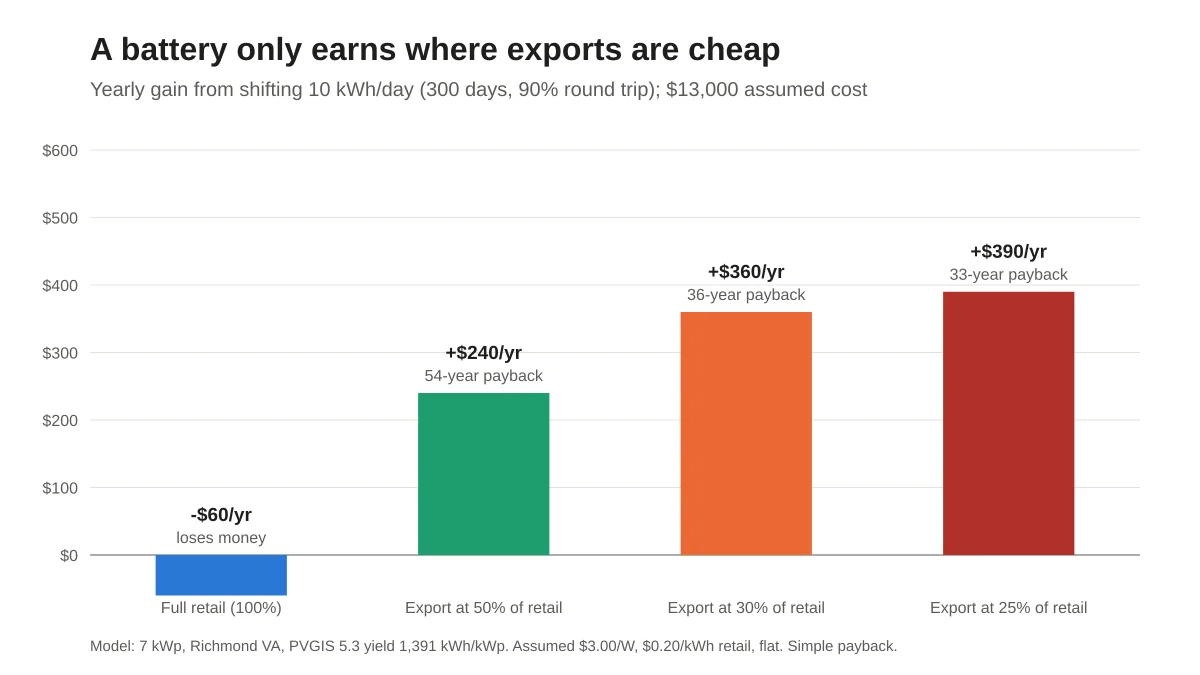
I modeled a battery shifting 10 kWh a day on 300 days a year at 90% round-trip efficiency, with an assumed $13,000 installed cost. The results:
- Full retail net metering: the battery loses about $60 a year. You're giving up 10% of each stored kWh to round-trip losses and gaining nothing, because the grid already credited that kWh at full price.
- Exports at 50% of retail: about $240 a year, a 54-year payback.
- Exports at 30% of retail: about $360 a year, 36 years.
- Exports at 25% of retail: about $390 a year, 33 years.
That's the uncomfortable part. Why buy a battery at all, then? Lower export rates make a battery more valuable, but on a flat retail rate the arbitrage alone still doesn't repay the hardware inside its warranty. What closes the gap is a time-of-use tariff with a big evening price, a demand charge like Colorado Springs' Option 2, backup value you'd pay for anyway, or a state battery incentive. Our home battery arbitrage model runs the warranty-limited version of that math, and the battery sizing guide covers how many kWh you'd actually cycle. If you're pricing hardware, the Tesla Powerwall 3 page lists its 13.5 kWh capacity and specs.
Cheaper ways to raise self-consumption come first. A heat pump water heater on a midday timer or an EV that charges at lunch costs nothing extra if you already own it. That's the idea behind daytime tariffs and thermal storage, and it usually beats a battery on cost per shifted kWh.
What Should You Do If Your State Is Reviewing Net Metering?
Four steps, in order:
- Find your grandfathering date. Colorado Springs uses the agreement date, Maryland uses a capacity cap, Virginia protects every existing NEM 1.0 customer. The date that matters is when your interconnection application is filed, not when the panels go up.
- Measure your real self-consumption. A year of hourly or 15-minute meter data tells you what share of your output you'd actually use. Most homes without a battery or daytime loads land well below half, which is the left side of my table.
- Size to use, not to roof. Under an export rate of 25 to 30% of retail, the extra panels that mostly export are the ones that stretch payback.
- Rerun the payback without incentives you can't count on. The federal 25D credit ended for owners at the end of 2025. What survives is in our 2026 tax credits and incentives guide.
What Are the Limits of This Analysis?
Three, and you should know them before quoting my numbers. First, the payback model uses a flat retail rate and ignores rate growth and degradation, which both matter over 20 years. Rate growth shortens every payback in the table; degradation lengthens it slightly. Second, I modeled self-consumption as a fixed share rather than simulating a household load profile, so the numbers show the shape of the trade-off rather than your bill. Third, the state list stops at what had a dated, public document by November 20, 2026. Quarterly trackers count dozens of open dockets, and some of them will become decisions before this article is a year old.
Summary
Net metering didn't end in 2026, but the direction is clear. Virginia kept annual netting for new Dominion customers and pays $0.05829 per kWh only for the yearly surplus. California's net billing survived its court challenge, Maryland and Connecticut ordered lower-credit successors due in 2027 and 2028, and Colorado Springs adopted grid access or demand charges with grandfathering to 2032. In my model, an export credit at 25% of retail stretched a 10.8-year payback to 27 years for a home using 20% of its output, but only to 12.7 years at 80% self-consumption. Under any export rate well below retail, self-consumption is the number to manage, and batteries pay only where time-of-use, demand charges or incentives add to the spread.