

The source is nuclear. The technology isn't. Sunlight is produced by nuclear fusion in the Sun's core, but a solar panel runs no reaction of any kind, and every nuclear power plant operating on Earth uses fission, which is the opposite process.
This question usually comes from somewhere sensible: if the Sun is a fusion reactor, isn't solar just remote nuclear power? It's a fair way to think about it, right up to the point where it changes any decision.
What Is the Sun Actually Doing?
The Sun is a ball of hydrogen and helium about 4.5 billion years old, roughly 93 million miles away, with a core temperature near 27 million degrees Fahrenheit, or 15 million Celsius (NASA). That temperature is the point: it's hot enough to sustain fusion.

The EIA's own nuclear explainer describes the mechanism without hedging. In fusion, atoms are combined to form a larger atom, and fusion is the source of energy in the Sun and stars. Hydrogen nuclei merge into helium, a small amount of mass becomes energy, and the result eventually escapes as photons.
So yes: trace the energy in your inverter far enough upstream and it is nuclear energy. So is wind, so is hydro, and so is the coal in a power station, since all of them run on stored sunlight. Once a definition includes almost everything, it has stopped being useful.
Are Fusion and Fission the Same Thing?
The distinction matters, because people who say "solar is nuclear" usually mean it resembles a nuclear plant. It doesn't, and here's why:
| Sun (fusion) | Nuclear plant (fission) | |
|---|---|---|
| Reaction | Light atoms combine | Heavy atoms split |
| Fuel | Hydrogen | Mined uranium, mostly |
| Location | 150 million km away | On site, in a reactor vessel |
| Waste | None reaching Earth | Spent fuel requiring long-term storage |
| Status on Earth | Not yet commercially viable | Operating for decades |
Every commercial reactor uses fission. The EIA notes researchers are still working on harnessing fusion, and whether it becomes commercially viable is not yet clear because controlling the reaction is hard. Meanwhile the Sun has been running a fusion reactor for us for 4.5 billion years, with the containment problem solved by putting it 150 million km away.
What Does a Solar Panel Actually Do?
Nothing nuclear whatsoever. A photovoltaic cell absorbs a photon, an electron gets enough energy to cross the silicon bandgap, and a p-n junction sends it round an external circuit. That's the photovoltaic effect, and it's an electronic process, not a nuclear one. The physics is set out in our guide on how panels make electricity.
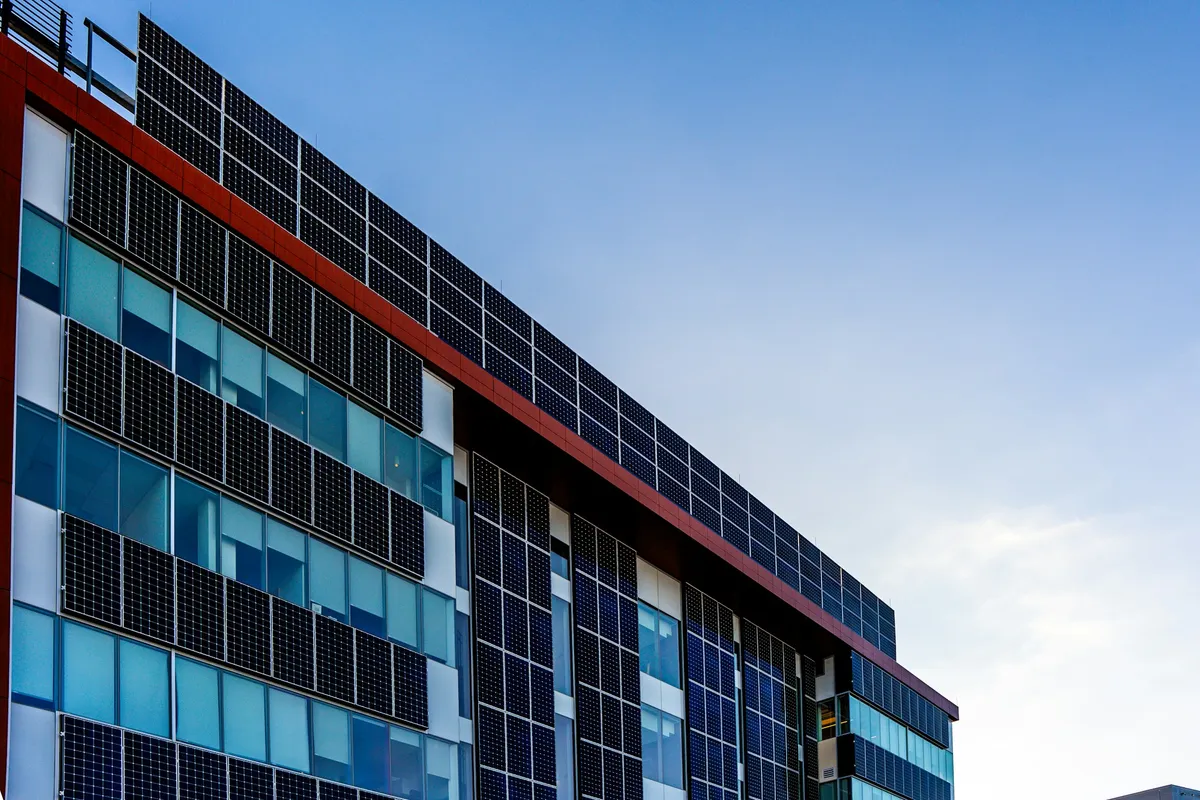
There's no fuel, no chain reaction, no shielding, no exclusion zone. Cover a panel and it stops. Try that with a reactor. What would a nuclear solar panel even contain? Nothing anyone has ever built, which is the shortest way to settle the question.
Is Radiation the Same as Radioactivity?
Two words that sound related and mean different things, which is where a lot of the worry comes from.
Radiation here means electromagnetic radiation: photons carrying energy across space. Sunlight is radiation. So is the Wi-Fi in your house and the visible light from a lamp.
Radioactivity is the spontaneous decay of unstable atomic nuclei, emitting ionising particles. Panels are silicon, glass, aluminium, polymer and copper. None of it decays, none of it is radioactive, and a panel emits nothing ionising while it works.
Are there environmental costs to panels? Certainly, and they sit in manufacturing energy, mining and end-of-life recycling, not in radioactivity. We looked at those honestly in is solar dirty energy.
Why Does Solar Get Classified the Way It Does?
Statistical agencies file solar under renewables and nuclear in its own category, and the reason is what each one consumes. A fission plant burns through mined uranium that has to be extracted, enriched, used and then stored for a very long time. Solar consumes nothing at all: the flux arrives whether you capture it or not, and the Sun's hydrogen budget is not affected by how many panels Arizona installs.
My view is that the fusion framing, while technically defensible, quietly flatters both technologies in ways that don't help anyone. Calling solar nuclear doesn't make it more impressive, and it doesn't make fission plants more natural. The useful comparison is what each costs, what each emits and how each behaves on a grid, not who shares a great-grandparent reaction.
Calling solar nuclear doesn't make it more impressive, and it doesn't make fission plants more natural.
Summary
Solar energy originates in nuclear fusion, and the EIA says so in as many words. It is not nuclear energy in any practical sense: the reaction is 150 million km away, panels contain no fuel or reaction, sunlight is electromagnetic radiation rather than radioactivity, and the only reactors on Earth run fission instead. Correct at the origin, misleading at the meter.