

Solar panels do use UV light - but only a fraction of it. Integrate the AM1.5G standard solar spectrum and the UV band (280 - 400 nm) holds about 4.6% of total solar irradiance reaching Earth's surface (ASTM G173-03, NREL Reference Solar Spectra). Even at a perfect 100% quantum efficiency, UV photons could supply only about 3% of the current a silicon cell can use, and with real-world efficiency and encapsulant losses the actual contribution is closer to 1% of output. The rest comes from visible and near-infrared light - and that gap between irradiance share and electrical contribution tells you a lot about how photovoltaics actually work. How that slice fits inside radiant energy as a whole is explained in solar versus radiant energy.

What Part of the Solar Spectrum Do Solar Panels Actually Use?
What arrives at ground level after passing through the atmosphere is described by the AM1.5G standard spectrum (ASTM G173-03), the international reference used to rate every commercial solar panel sold today. Here's how that spectrum divides up at Earth's surface:
| Wavelength Band | Range | Share of Total Irradiance | Silicon PV Response |
|---|---|---|---|
| Ultraviolet (UV) | 280 - 400 nm | ~4.6% | Partial - low quantum efficiency |
| Visible | 400 - 700 nm | ~43.0% | Strong - high efficiency zone |
| Near-infrared (NIR) | 700 - 1,100 nm | ~32.9% | Strong - silicon's peak response range |
| Longer infrared | >1,100 nm | ~19.6% | None - photons too weak to excite electrons |
Source: integration of the ASTM G173-03 AM1.5G global-tilt reference spectrum (1,000 W/m^2 total over 280 - 4,000 nm), as published by NREL
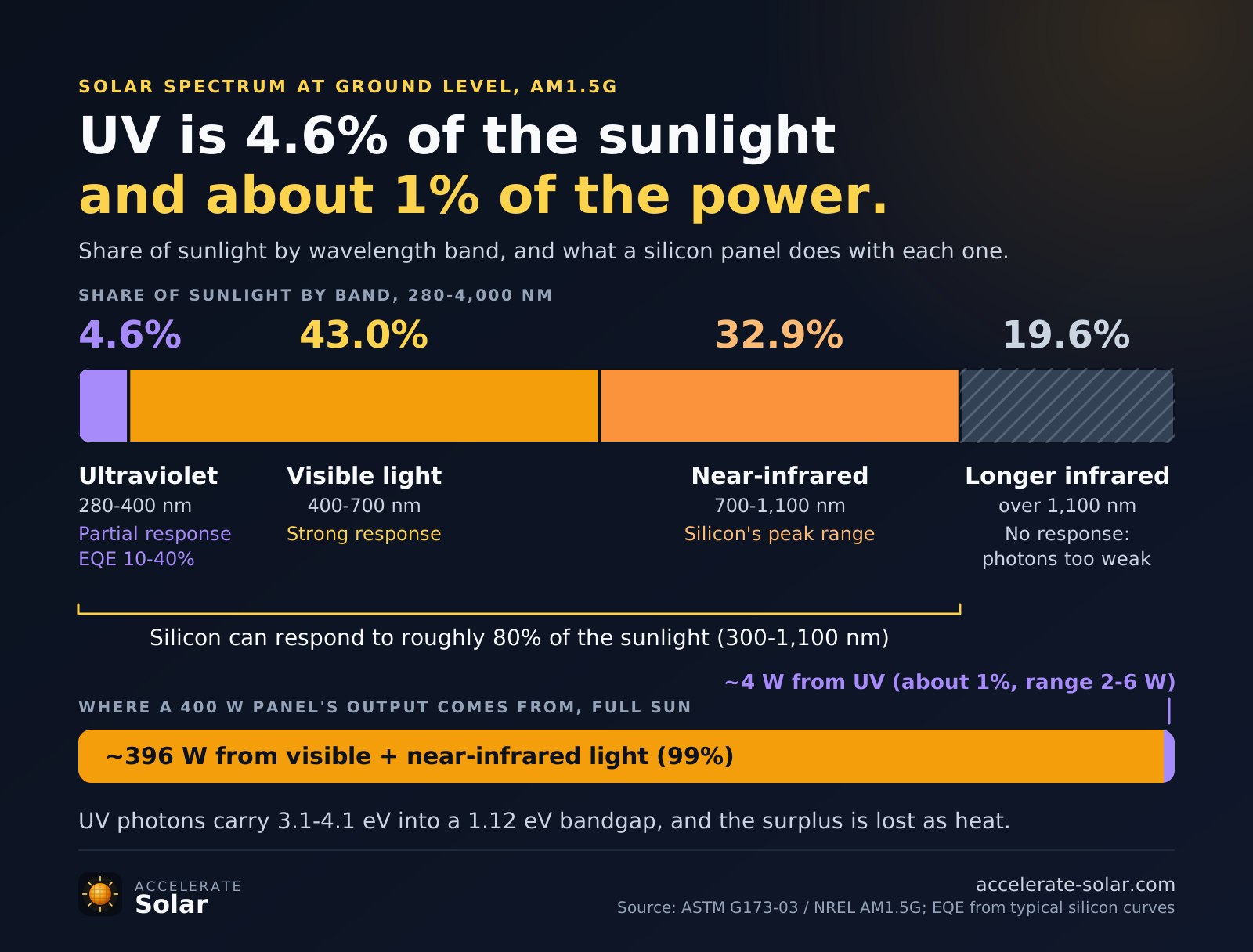
Standard monocrystalline silicon responds to light from roughly 300 nm to 1,100 nm, so it technically covers UV through near-infrared, but responding and converting efficiently aren't the same thing. The glass cover and EVA encapsulant absorb some UV before it reaches the cells, and silicon's quantum efficiency drops sharply below 450 nm.
Why Does Silicon Extract So Little Energy from UV?
Silicon has a bandgap of 1.12 eV. To generate current, a photon must carry at least that much energy. UV photons at 300 - 400 nm carry 3.1 to 4.1 eV - roughly three times what silicon needs - and the surplus becomes heat (thermalization loss), wasting about two-thirds of each absorbed UV photon's energy as lattice vibration rather than current. The Shockley-Queisser limit for a 1.12 eV bandgap sits near 33%, and silicon's own Auger recombination pulls the practical ceiling down to about 29.4% (Richter et al., 2013). The full cell physics, from the depletion zone to the V-I curve, sits in solar cell physics and MPP tracking.
Typical crystalline-silicon quantum-efficiency curves make it concrete: external quantum efficiency (EQE) of 80 - 90% between 600 nm and 950 nm, falling to 40 - 60% in the blue/violet range, and dropping to roughly 10 - 40% across the UV, lower still once glass and encapsulant have absorbed the shortest wavelengths. Weight the AM1.5G photon flux by a curve like that and UV supplies about 0.4 - 1.5% of the photocurrent, which is where the roughly 1% figure comes from. UV's 4.6% share of irradiance becomes a rounding error in output. See our guide to increasing solar PV yield for how spectral response interacts with real-world factors.
How Much UV Contribution Can You Expect From Your Panels?
Take a typical 400 W residential monocrystalline panel in full sun (1,000 W/m^2 irradiance):
- ~396 W traces back to visible and near-infrared photons (about 99% of output)
- ~4 W traces back to UV photons (about 1%, with a plausible range of 2 - 6 W)
That's before the real-world losses from heat, reflection and wiring, which hit the whole spectrum alike.
On a partly cloudy day, diffuse irradiance skews toward shorter wavelengths (more blue and UV, since short wavelengths scatter more), but silicon is already least efficient there, so cloudy-day losses come far more from reduced total irradiance than from any spectral shift. UV isn't what's limiting your system - shading, panel mismatch, inverter efficiency, and soiling matter far more. If you're chasing lost yield, look there first.

Does UV Light Damage Solar Panels Over Time?
Yes, gradually - and this matters more to most homeowners than UV capture does. UV triggers photo-oxidation in the EVA encapsulant bonding cells to the front glass, which yellows and transmits less light over time. Arizona field data - one of the highest-UV climates used for accelerated aging - is the usual yardstick. Six modules that had spent 21 years there showed a short-circuit current loss of 0.43% per year, mostly from encapsulant discoloration (Sinha et al., ASU/NREL, IEEE 2020). Over 21 years that's about 9% of the current, or roughly 36 W on a 400 W panel if it all carries through to power. It's a hot, dry, high-UV worst case rather than a forecast for your roof, and panel-level monitoring flags this kind of slow loss years before visual inspection would.
Manufacturers counter this with UV-stabilized or UV-blocking encapsulants (POE in place of plain EVA in many newer panels), low-iron tempered glass with anti-reflection coating, and UV-resistant backsheets. A separate silicon nitride layer on the cell itself is why panels look nearly black. IEC 61215:2021 requires UV preconditioning at 15 kWh/m^2 before electrical testing, and every mainstream brand publishes compliance in its datasheets. The SolarEdge P370 power optimizer doesn't change spectral response, but its per-panel MPPT stops one degraded panel from dragging down a whole string.
Potential Induced Degradation (PID) is a separate failure mode, often confused with UV damage since both accelerate in hot, humid, high-UV climates. PID occurs when high DC voltage drives sodium ions through the glass into the cell, and in severe cases it has cost a panel up to about 30% of its power within a few years. UV doesn't cause PID directly, but it degrades the encapsulant barrier that slows sodium migration, so high-UV sites carry higher PID risk. Panels rated PID-resistant (tested per IEC 62804) combine UV-stable encapsulants, resistive backsheets, and cell passivation - check for both IEC 61215 and IEC 62804 compliance when buying for a high-UV climate.
There's also a newer UV problem that older panels didn't have. PVEL's reliability scorecard tests modules at a 120 kWh/m^2 UV dose and finds that n-type TOPCon cells can lose real power to UV-induced degradation (UVID): the median TOPCon bill of materials lost 3.0% in the latest edition, down from 4.2% in the previous edition. The spread is wide: PVEL cites one supplier's cells losing 14.1% under one process recipe and 3.6% under another. Encapsulant choice matters too, since UV-blocking layers cut the loss. Outdoor year-one losses of up to 8% were seen in the scorecard's optional field test in Davis, California. Ask for a manufacturer's UVID results, not just IEC 61215 compliance.
Can Newer Solar Technologies Capture UV More Efficiently?
Standard silicon won't improve much at UV absorption - the 1.12 eV bandgap sets a hard limit. Perovskite-silicon tandem cells stack a perovskite top layer with a wider, tunable bandgap (1.6 - 1.8 eV) over a silicon bottom cell, absorbing UV and blue-visible photons efficiently while silicon handles red and NIR. That architecture reached a certified lab efficiency of 35.5% (LONGi Solar, ESTI-certified, announced July 2026), up from 34.85% (NREL-certified, April 2025), against a theoretical two-junction limit of roughly 45%. It's a lab cell, not a product you can buy. Luminescent solar concentrators, still mostly R&D, down-convert UV photons before they hit the cell. Standard bifacial panels don't capture more UV; their rear gain comes from reflected visible light.
For how commercial silicon types handle spectral efficiency and UV resilience, see our TOPCon vs HJT vs PERC comparison. Don't assume a newer n-type cell is automatically more UV-resilient than PERC, though; UVID results vary more by manufacturer and encapsulant than by cell label. Temperature matters more day to day than UV, as our guide on solar panels in cold weather explains.
The spectrum reaching your panels isn't static - mornings and evenings, sunlight crosses a thicker atmospheric path, reddening the spectrum toward NIR, which silicon handles slightly better. Overcast skies carry more blue and UV, but with silicon weakest there and total irradiance far lower, that spectral shift is a secondary effect - your panels underperform on cloudy days because less total energy arrives, not because they can't use blue-heavy diffuse light.
Summary
Solar panels do convert UV into electricity, but UV contributes only about 1% of output in standard silicon PV. The usable spectrum spans roughly 300 - 1,100 nm, peaking between 650 nm and 950 nm where silicon's EQE hits 80 - 90%. UV photons carry too much energy for silicon's 1.12 eV bandgap, so most is lost as heat. UV also yellows encapsulant, can trigger UVID in some n-type cells, and can accelerate PID in poorly specified systems, which is why IEC 61215 and IEC 62804 testing exists and why UVID results are worth asking for. Emerging tandem and perovskite cells use UV far better, but for standard residential silicon today, UV capture isn't the bottleneck - shading, mismatch, and soiling losses are far larger, and fixable. For a full breakdown of yield strategies, see our complete solar system optimization guide.